
-
Your next favorite book
is waiting.
Summary | Excerpt | Reviews | Beyond the Book | Readalikes | Genres & Themes | Author Bio
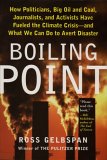
How Politicians, Big Oil and Coal, Journalists and Activists Are Fueling the Climate Crisis--and What We Can Do to Avert Disaster
by Ross Gelbspan Book Reviewed by:
The conference yielded a 'call to action' by the treasurers and controllers of California, New York State, New York City, Connecticut, New Mexico, Oregon, Maine, and Vermont, as well as officials overseeing two major union pension funds. Noting that state treasurers and pension fund managers oversee $1 trillion in assets, the group called on regulators and business leaders to force corporations to give investors more information on the financial risks from global climate change.
Said California treasurer Philip Angelides: 'In global warming, we are facing an enormous risk to the U.S. economy and to retirement funds that Wall Street has so far chosen to ignore.'
In contrast to European insurers, however, few, if any, U.S.-based insurance companies are acknowledging the threat of climate change.
In June 2002, the State Farm Insurance Company did announce that losses in its home insurance business were prompting it to limit or halt the sale of new policies in twenty states, due to storms, floods, and other extreme weather events. But the company's announcement failed to acknowledge that any connection between the heating of the atmosphere and the increase in destructive weather extremes was forcing it to cut back on its areas of coverage.
Gene Lecomte was a former president of the Institute for Business and Home Safety as well as CEO of the Insurance Institute for Property Loss Reduction, a consortium of large U.S.-based insurers. He outlined the differences between European and U.S. insurers at a January 2003 conference at Tufts University. 'In Europe, insurers are involved in formulating government policy. They are acutely aware of the potential losses from climate impacts.'
Among U.S. insurers, by contrast, there is 'distrust of government, a great deal of parochialism and a set of very different agendas.' Insurers in the United States, Lecomte said, 'continue to insist there are major uncertainties in the science. There is a great lack of knowledge about climate change among U.S. companies-and a strange kind of parochialism among stakeholders.'
Rather than press for industrywide changes to address the problem, he said, U.S. insurers are simply 'burying their heads' and withdrawing coverage from coastal areas, known storm corridors, and other places that are vulnerable to weather extremes. Moreover, several U.S. insurers have passed on the risks of climate-driven losses to the public in the form of so-called catastrophe bonds. The bonds, which are backed by insurers and pay double-digit dividends, seem to be attractive investment vehicles for retirees living on fixed income. But they involve considerable risk. If the insurer loses $1 billion due to a natural disaster, the bondholder loses not only the dividend but the principal as well. What many bondholders may not realize is that the United States has suffered more than forty such loss events exceeding $1 billion since 1980.
Noting that about half of all property insurance in the United States is underwritten by about twenty companies, Lecomte called on stakeholders to push the industry to address the risks of climate change. 'What is really needed is for all stakeholders to figure out how to make the industry more beneficial, to make it work the way it should. And that includes not only changing corporate cultures, but also changing regulations that discourage companies from setting aside money to cover future damages and that fail to recognize the need for more research into coming climate impacts.'
Any reform of the industry, he concluded, must begin with insurers seeing to it that 'property owners must understand there are no free rides.'
In 1997, President Bill Clinton convened a White House Conference on Climate Change, which featured, among other personages, a dazzling array of prominent business leaders. The following January, Clinton continued to focus public attention on the threat of climate change in his State of the Union address.
From Boiling Point by Ross Gelbspan, pages 93-126 of the hardcover edition. Reprinted with Permission from Basic Books – Copyright 2004.







Every good journalist has a novel in him - which is an excellent place for it.
Click Here to find out who said this, as well as discovering other famous literary quotes!

Can you name the title?
Test your book knowledge with our daily trivia challenge!
Your guide toexceptional books
BookBrowse seeks out and recommends the best in contemporary fiction and nonfiction—books that not only engage and entertain but also deepen our understanding of ourselves and the world around us.

&url=https://www.bookbrowse.com/excerpts/index.cfm/book_number/1474/page_number/9/images/touch/apple-touch-icon-144x144.png)


