Summary | Excerpt | Reading Guide | Reviews | Beyond the Book | Readalikes | Genres & Themes | Author Bio

Critics' Opinion:
Readers' Opinion:
First Published:
May 2004, 256 pages
Paperback:
Aug 2005, 304 pages
 Book Reviewed by:
BookBrowse Review Team
Buy This Book

Foreword
Acknowledgments
Introduction: The Marketing Maelstrom
Appendix Resources
Notes
Suggested Reading
Index
Introduction:
The Marketing Maelstrom
My daughter is a popular kid these days. Taco Bell wants her, and so does Burger King. Abercrombie and Fitch has a whole store devoted to her. Pert Plus has a shampoo she'll love. Ethan Allen is creating bedroom sets she can't live without. Alpo even wants to sell her dog food.
With a single-minded competitiveness reminiscent of the California gold rush, corporations are racing to stake their claim on the consumer group formerly known as children. What was once the purview of a few entertainment and toy companies has escalated into a gargantuan, multi-tentacled enterprise with a combined marketing budget estimated at over $15 billion annually—about 2.5 times more than what was spent in 1992. Children are the darlings of corporate America. They're targets for marketers of everything from hamburgers to minivans. And it's not good for them.
Even while I, like all American parents, am held responsible for the behavior of my child and for safeguarding her future, corporations bombard her with messages that undermine my efforts. One advertisement for a violent movie, a few sexual innuendos to get her to buy a certain brand of jeans, or a couple of commercials urging her to eat junk food are not going to harm my daughter. But kids today are growing up in a marketing maelstrom. That children influence more than $600 billion in spending a year has not been lost on corporate America, which seeks to establish "cradle to grave" brand loyalty among the purchasers of its goods and services. Every aspect of children's lives—their physical and mental health, their education, their creativity, and their values—is negatively affected by their involuntary status as consumers in the marketplace.
There's no doubt that advertising works. Its success stories are told and retold within the industry. At mid century the phrase "A Diamond Is Forever" succeeded so well in bolstering a faltering diamond market that by 1951, 80 percent of American marriages began with a diamond engagement ring. In the mid-1950s only 7 percent of American women dyed their hair; six years after Clairol introduced their "Does she or doesn't she?" campaign, one study reported that 70 percent of all women were coloring their hair. In 1970, just before McDonald's began telling moms that they "deserve a break today," annual sales were at $587 million; by 1974, after four years of that catchy little jingle, annual sales jumped to $1.9 billion.
So what's the big deal? What's wrong (leaving aside for the moment the questions of where those diamonds come from, and whether hair dye and fast food enhance your well-being or physical health) with trying to get people to buy a diamond engagement ring, or dye their hair, or indulge in the occasional Big Mac with fries? Well, all of these legendary campaigns were aimed at adults, who presumably can bring a certain amount of information and judgment to their decisions about what's good for them.
From Consuming Kids by Susan Linn, pages 1-10. Copyright Susan Linn 2004. All rights reserved. No part of this book maybe reproduced without written permission from the publisher, The New Press.



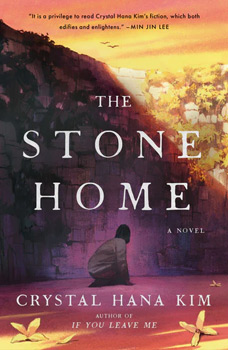
The Stone Home
by Crystal Hana Kim
A moving family drama and coming-of-age story revealing a dark corner of South Korean history.

The House on Biscayne Bay
by Chanel Cleeton
As death stalks a gothic mansion in Miami, the lives of two women intertwine as the past and present collide.
More Anagrams
Click Here to find out who said this, as well as discovering other famous literary quotes!
Your guide toexceptional books
BookBrowse seeks out and recommends the best in contemporary fiction and nonfiction—books that not only engage and entertain but also deepen our understanding of ourselves and the world around us.