
-
Your next favorite book
is waiting.
Summary | Excerpt | Reviews | Beyond the Book | Readalikes | Genres & Themes | Author Bio
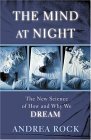
The New Science of How and Why we Dream
by Andrea Rock Book Reviewed by:
Aserinsky loved physiology, but he had no intrinsic interest in sleep research. He became even less enthusiastic about his fate when he found that Kleitman--whom he described as "a man with a grey head, a grey complexion and a grey smock"--was usually tucked away out of sight behind his closed office door, responding with irritation whenever Eugene knocked. Kleitman may not have found him the best prospect for a graduate assistant, either, but as Aserinsky dryly observed, the primary criterion for selecting a graduate assistant "was that the candidate have a heartbeat." Since Aserinsky did qualify on that score, Kleitman immediately gave him a research task: observing sleeping infants to see whether blinking stopped gradually or suddenly as they fell asleep.
After several unproductive months pursuing Kleitman’s goal, Aserinsky gathered his courage to knock on what he referred to as "the dreaded door" to propose a different project: studying eye movements of sleeping subjects throughout an entire night. He’d observed vigorous eye movements behind the closed lids of subjects who were sleeping, and he wondered whether those movements were haphazard or had some pattern and purpose. To his surprise, Kleitman agreed to the change, suggesting that Aserinsky pursue the project as a potential doctoral dissertation. He mentioned that there was an old polygraph machine stored in the basement of the physiology building that he might be able to use to record eye movements as well as brain waves and other physiological measurements on his test subjects. Well aware that he was taking a big risk--if the experiments produced no new data worthy of a doctoral dissertation, he would be continuing his pattern of collecting college credits without earning a degree--Aserinsky decided to proceed anyway.
"According to my anti-intellectual ‘Golden Manure’ theory of discovery, a painfully accurate, well-focused probe of any minutiae is almost certain to divulge a heretofore unknown nugget of science," he later said. "What lay ahead was a gamble--the odds being that since no one had really carefully examined the eyes of an adult through a full night’s sleep, I would find something. Of course, the importance of that find would determine whether or not I would win the gamble."
Just as Eugene had been recruited into partnership with his father, Aserinsky enlisted the aid of his son, Armond, in his own brand of wagering. Starting in second grade, the boy began logging countless hours in the lab, first serving as a test subject himself and then helping his dad set up and calibrate the rickety recording equipment for other sleep subjects.
"The lab was horrendous--old and dark with stone walls--and the machine was ancient, so it was always breaking down," recalls Armond, who is now a clinical psychologist. "Getting prepped for the recording procedure was uncomfortable and I didn’t like the all-night sessions, but I knew my dad needed help, and I was flattered that he talked over his findings with me and always took what I said very seriously."
The abandoned polygraph Aserinsky had rescued from the basement of Abbott Hall turned out to be one of the first machines of its kind. It picked up eye movements and brain waves through electrodes pasted on the subject’s head and then translated those electrical signals into ink patterns scratched out by several pens onto long reams of paper. Recording a single night’s sleep session consumed a stream of polygraph paper a half mile long.
This technique for recording electrical signals from the brain had been around since the early part of the twentieth century, when Hans Berger, a German neuropsychiatrist was able to record brain waves in subjects who were awake but relaxing with their eyes closed. He observed that these EEG (electroencephalogram) patterns showed consistent changes at sleep onset; subsequent studies in the 1930s at Harvard further classified differences in waking and sleeping brain wave patterns. But no one had tried all-night recordings of brain and eye movements as Aserinsky was doing, in large part because Kleitman and others mistakenly believed that sleep was a second-class state during which nothing important happened in the brain other than maintenance of basic body functions.
From The Mind at Night, chapter 1, pages 1-16. Copyright 2004 by Andrea Rock. All rights reserved. No part of this book may be reproduced in any manner whatsoever, except for brief quotations embodied in critical articles with reviews, without written permission from the publisher, Basic Books.







These are not books, lumps of lifeless paper, but minds alive on the shelves
Click Here to find out who said this, as well as discovering other famous literary quotes!

Can you name the title?
Test your book knowledge with our daily trivia challenge!
Your guide toexceptional books
BookBrowse seeks out and recommends the best in contemporary fiction and nonfiction—books that not only engage and entertain but also deepen our understanding of ourselves and the world around us.

&url=https://www.bookbrowse.com/excerpts/index.cfm/book_number/1405/page_number/2/images/touch/apple-touch-icon.png)


