Summary | Excerpt | Reviews | Readalikes | Genres & Themes | Author Bio
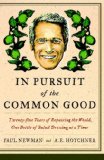
Twenty-Five Years of Repairing the World, One Bottle of Salad Dressing at a Time
Critics' Opinion:
Readers' Opinion:
First Published:
Nov 2003, 272 pages
Paperback:
Sep 2008, 272 pages

Chapter One
It is December, 1980, a week before Christmas, Westport, Connecticut, a blanket of snow on the ground, wood smoke from fireplaces redolent in the air, tree lights festooning the houses, a pervasive Yuletide lilt but we are laboring in the subterranean space beneath Paul's converted barn, an area that had once been a stable for farm horses. There is a bucket filled with ice-blanketed Budweisers, and an array of bottles of olive oil, vinegar, mustard, condiments, etcetera. There is also an empty tub and a collection of old bottles dating back to revolutionary times by their appearance, bottles of various shapes and sizes that had been somewhat sanitized for this occasion.
Paul Newman, known to his friends as ol' PL or Calezzo de Wesso (Bonehead), had asked his buddy, A.E. Hotchner (Hotch), sometimes called Sawtooth, to help him with a Christmas project that he was assembling in this basement, which wasn't a basement in the usual sense. There were crusty stones, a dirt floor, crumbling cement, and overhead timbers covered with active cobwebs. Also, three long-since vacated horse stalls but the unmistakable aroma of horses remained. There were desiccated manure fragments here and there, and there was evidence that certain field animals were still occupying the premises. A very picturesque place in which to mix salad dressing.
The project was to mix up a batch of PL's salad dressing in the wash tub, fill all those old wine bottles using the assembled funnels and corks and labels and on Christmas Eve our collective families would go around the neighborhood singing carols and distributing these gift bottles of PL's dressing.
PL was very proud of his salad dressing and this was the apotheosis of his salad days. Over the years, even in four-star restaurants, PL had been rejecting the house dressings and concocting his own. Captains, maitre d's and sometimes the restaurant owner would scurry around to assemble Paul's ingredients while neighboring diners gawked in disbelief. When we first ate at Elaine's, one of New York's popular restaurants, several waiters and Elaine herself gathered round as Paul blended and tasted the brew he made from the ingredients brought to him from the kitchen. This scene had been repeated in such varied eateries as a Greek diner, at a wedding party, in an outdoor restaurant, on the island of Eleuthera and in snazzy restaurants from coast to coast. When his kids went off to school, Paul would fill a couple of bottles of dressing for them to take along. On one occasion, when the restaurant mistakenly served the salad with its own dressing, Paul took the salad to the men's room, washed off the dressing, dried it with paper towels, and returning to the table, anointed it with his own which he concocted with ingredients brought to him from the kitchen.
At that time, almost all dressings, especially the mass market ones, contained sugar, artificial coloring, chemicals to preserve, gums and God knows what. So Paul really started to make his own dressing not just as a taste preference, but also as a defense against those insufferable artificial additives.
That evening the basement operation seemed to go on forever. We had never tried to mix a vat of salad dressing let alone pound a 1925 syrup cork into an 1895 vinegar bottle, especially after a few beers. Sometimes the mallet would smack the cork and sometimes it nailed our thumbs. Paul carefully measured amounts of olive oil and vinegar, for he had no feel yet for dealing with a quantity like this, which, he decided, required six boxes of black pepper. He was almost crazed as he stirred the dressing with the wooden paddle. There's a river that runs alongside his house and the paddle most certainly came from his canoe. It was his notion that the olive oil and vinegar had a sort of hygienic effect so that one didn't have to wash anything thoroughly. That aside, he was highly critical of Hotch's paddle technique. The motion, he insisted, had to have an even, smooth rhythm that would not create frothing. But Hotch couldn't get the hang of it. "You've got to go with the paddle," Paul said, "don't pull it straight toward you, waffle it, gyrate it, go with the paddle." Hotch said he was going with the paddle but having had four beers, if he went with the paddle too much he was going to fall face down in the tub. Paul said as long as it wasn't butt first, not to worry about it.

Copyright 2003 The Association of the Hole in the Wall Gang Camps and A.E. Hotchner





The House on Biscayne Bay
by Chanel Cleeton
As death stalks a gothic mansion in Miami, the lives of two women intertwine as the past and present collide.

The Flower Sisters
by Michelle Collins Anderson
From the new Fannie Flagg of the Ozarks, a richly-woven story of family, forgiveness, and reinvention.

The Funeral Cryer by Wenyan Lu
Debut novelist Wenyan Lu brings us this witty yet profound story about one woman's midlife reawakening in contemporary rural China.
Your guide toexceptional books
BookBrowse seeks out and recommends the best in contemporary fiction and nonfiction—books that not only engage and entertain but also deepen our understanding of ourselves and the world around us.