return to home  
Join   |  Gift   |  Member Login   |  Library Login
BookBrowse Mobile
Follow Us: 
    Book Summary and Reviews

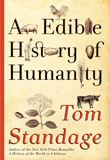
An Edible History of Humanity: Book summary and reviews of An Edible History of Humanity by Tom Standage

An Edible History of Humanity

An Edible History of Humanity
by Tom Standage
Published in USA May 2009,
288 pages.

Publication information


Critics' Opinion: 
Readers' Rating: 
About BookBrowse Rankings
Share: 
Buy This Book

An Edible History of Humanity Summary

The bestselling author of A History of the World in 6 Glasses brilliantly charts how foods have transformed human culture through the ages.

Throughout history, food has acted as a catalyst of social change, political organization, geopolitical competition, industrial development, military conflict, and economic expansion. An Edible History of Humanity is a pithy, entertaining account of how a series of changes—caused, enabled or influenced by food—has helped to shape and transform societies around the world.

The first civilizations were built on barley and wheat in the Near East, millet and rice in Asia, corn and potatoes in the Americas. Why farming created a strictly ordered social hierarchy instead of the egalitarianism of hunter-gatherers is, as Tom Standage reveals, as interesting as the details of the complex cultures that emerged, eventually interconnected by commerce. Trade in exotic spices spawned the age of exploration and colonization of the New World.

Food’s influence over the course of history extends into modern times. In the late eighteenth century Britain’s solution to food shortages was to industrialize and import food rather than grow it. Food helped to determine the outcome of wars: Napoleon’s rise and fall was intimately connected with his ability to feed his vast armies. In the twentieth century, Communist leaders employed food as an ideological weapon, resulting in the death by starvation of millions in the Soviet Union and China. And today the foods we choose in the supermarket connect us to global debates about trade, development, the environment, and the adoption of new technologies. Drawing from many fields, including genetics, archaeology, anthropology, ethno-botany, and economics—and invoking food as a special form of technology—An Edible History of Humanity is an appetizing and fully satisfying discourse on the sweep of human history.

An Edible History of Humanity Reviews

"Some topics, like the spice trade's encouragement of exploration, are fairly obvious choices, but the concise style and inclusion of little-known details keep the material both entertaining and enlightening." - Library Journal

"An intense briefing on the making of our world from the vantage point of food history." - Kirkus Reviews

The information about An Edible History of Humanity shown above was first featured in "The BookBrowse Review" - BookBrowse's online-magazine that keeps our members abreast of notable and high-profile books publishing in the coming weeks. In most cases, the reviews are necessarily limited to those that were available to us ahead of publication. If you are the publisher or author of this book and feel that the reviews shown do not properly reflect the range of media opinion now available, please send us a message with the mainstream media reviews that you would like to see added.

An Edible History of Humanity Reader Reviews

Write your own review

Rated 5 of 5 of 5 by Eileen C. (Arlington, TX)
History and food.
Excellent book by the author of the "History of the World in Six Glasses". Unlike the previous book there is not a timeline followed in this book, there are historical topics and food. The reader experiences how the cultivation of wild foods changed to food traits more favorable for human cultivation, instead of traits that might have lead to greater spread of foods. Revealed is how specialized societies developed from changes from a hunter/gatherer to agricultural society. How searching for new foods expanded knowledge of the world, and how foods from the new world led to better farming and the industrial revolution. How the ability to supply food to troops changed wars is covered as is the question of how the growing world can be fed today.

I recommend this book as an enlightening view of how foods have contributed to history and the world as we know it.

Rated 5 of 5 of 5 by Kathy P. (Saratoga, CA)
Accessible and Insightful
Standage convincingly transforms colorful side notes from old world history texts -- spice trade routes, the domestication of grain -- into the dominant, driving forces that shaped human civilization. Lifelong learners will enjoy perusing these well-researched pages. He illuminates credible premises in entertaining, informative ways -- such as how Britain's food supply logistics helped the American Revolution to succeed, or how the existence of the potato made Britain's Industrial Revolution possible. Even well-honed trivia buffs will find new conversational highlights and factual gemstones here. This book could easily serve as a college textbook or reference resource.

Rated 5 of 5 of 5 by Claire M. (Hilton Head, SC)
Food through the Ages...
Without great thought most of us have perhaps thought that history has influenced food but the opposite is true - food has written history. Who would be thinking farming was an alien activity 10,000 years ago? The mutations of corn, rice, wheat and other grains over the millennia, from a grass into a so called cereal, which can only be grown by man is illustrative of the current food supply. Standage’s book is a very interesting story of how we have gotten to where we are through the domestication of grain and livestock. And here I stand; an opponent of genetic engineering who has not understood the precedents!

What this book also shows us is that we should follow the food, not the money in order to understand the growth of societies. Today we take food for granted in a country dominated by agribusiness - cheap food for cheap health. Though many of us may want to eat and think local it behooves us to understand the inter dependence of global agribusiness and populations which have led us to these desires. Thomas Malthus, wars, famines, Norman Borlaug, synthesizing ammonia, and feeding huge populations - all of these many people and events are shown by Standage to have brought us to what we eat now. I’m delighted to have learned what I have, to understand the interrelationships, the history of food and civilizations in reading this very interesting book.


dee

Rated 4 of 5 of 5 by Kelly P. (Monterey, TN)
An enjoyable book
Overall, I found An Edible History of Humanity to be an enjoyable and informative book. The author traces the impact of food on human civilization by addressing such topics as global trade, political policy, warfare, and scientific development. While there are not many stunning new revelations, the book does entertain and inform the reader. The information is presented in a logical manner, the writing is crisp, the examples are appropriate, and most importantly the author avoids the dreaded “information dump” that plagues too many histories.

Rated 4 of 5 of 5 by Mark O. (Wenatchee, WA)
Food and the Turning Points of History
Standage writes on “… the intersections between food history and world history, to ask a simple question: which foods have done most to shape the modern world, and how?” So, this book is coarse-grain history, telling us about the sprouting of civilizations from the domestication of wheat, barley, rice, corn, and potatoes. We “follow the food” as trade (especially in spices) cross-fertilizes the cultures of continents. “Give us this day our daily bread” makes logistics as important as munitions in waging war and give tyrants an almost irresistible means of coercion. Perhaps the best fodder for reading groups is the generous view of the green revolution and industrial agriculture, provoking discussion of food that is at least local, if not slow.

I suspect that readers of books on history naturally form two groups: those driven by narrative and those for whom history is visual and illustrations are essential. I especially missed having enough readable maps showing past peoples and the connecting arrows that signify camel routes and voyages in small wooden ships. This was remedied by having “The Times Atlas of World History” close at hand.*

Food is the everything of our lives, from food stamps to the commodity prices of the corn that makes the tortillas in the barrios to the omega-3-containing salmon that might save our hearts. “An Edible History of Humanity” could be a good short course in a curriculum of books about food.

*Editor's note, Mark was reviewing an advanced reader's copy (ARC) of An Edible History of Humanity, oftentimes maps and other illustrations are not included in the ARC but are available in the finished version.

Rated 4 of 5 of 5 by Kevin
An Edible History of Humanity
The author puts forward his views that all large transformations in history were caused, enabled or influenced by food. The change as humans left hunter-gatherer societies and become agrarian societies allowed people to have the ability to stay in one place, to own personal items (because they did not have to carry them), to grow into various class distinctions, to eventually allow those in control to have others get food for them. The author argues that food (or the lack thereof) was the main reason for wars to occur.
A very interesting history. I was not expecting much but enjoyed the book. I don't think I will ever look at corn in the same way again.

...9 more reader reviews

Tom Standage Author Biography

Tom Standage is the business editor at The Economist magazine and the author of five history books, An Edible History of Humanity (2009), A History of the World in Six Glasses (2005), The Turk (2002), The Neptune File (2000) and The Victorian Internet (1998), at least two of which have been serialized as "Book of the Week" on BBC Radio 4.  The Victorian Internet: How The Victorians Wired the World, was made into a Channel 4 documentary.

He has previously covered science and technology for a number of newspapers and magazines, including The Guardian,...

... Full Biography

Other books by Tom Standage at BookBrowse

A History of the World in 6 Glasses jacket

Recently Published History, Science & Current Affairs

more...


Become a Member
Click Here
Editor's Choice
  •  May 18 
  •  May 16 
  •  May 15 
The Woman Upstairs
Claire Messud

The Woman Upstairs Jacket

The riveting confession of a woman awakened, transformed, and betrayed by passion and desire for a world beyond her own.
How to Create the Perfect Wife
Wendy Moore

How to Create the Perfect Wife Jacket

Stranger than fiction, blending tragedy and farce, How to Create the Perfect Wife is an engrossing tale of the radicalism, and deep contradictions, at the heart of the Enlightenment.
Happier Endings
Erica Brown

Happier Endings Jacket

A wise and affirming meditation on living fully and preparing for death, written by a highly regarded spiritual teacher.
Click Here
   Most Recent Blog Entries
Jewish Young Adult Books That Are Not About The Holocaust
Books to Give This Mother's Day
A Short History of Chechnya
rss  RSS   rss  subscribe
Recent Reader Reviews
Flight Behavior by Barbara Kingsolver
Although heavy on the scientific details, which slowed down the story for me (OK, I admit, I was one of those liberal arts majors who skipped out on... read more
The House at the End of Hope Street by Menna van Praag
Loved this book. Magical, quirky, enchanting I could go on. All books do not have to be literary fiction, sometimes it is just so comforting to read... read more
Ordinary Grace by William Kent Krueger
Can an wiser, older narrator view the past with more wisdom than he might have possessed forty years earlier in the summer he was thirteen? Ordinary... read more
RSS RSS feed More...  
Most Viewed This Week
Book Club Recommendations
The Gods of Gotham
by Lyndsay Faye
Paperback (Mar/13)
Forgotten Country
by Catherine Chung
Paperback (Mar/13)
Philida
by André Brink
Paperback (Feb/13)
Gone Girl
by Gillian Flynn
Hardback (Jun/12)
More...
First Impressions
Members read and review books often months before they're published. See what they think in First Impressions!
A Dual Inheritance
by Joanna Hershon
Four Stars            (May/13)
The Laws of Gravity
by Liz Rosenberg
4.5 Stars            (May/13)
The Sisterhood
by Helen Bryan
Four Stars            (Apr/13)
More...
  Latest BookBrowse News
U.S. ebook sales up in 2012, but rate of growth is slowing (May 16 2013)
In 2012, trade book sales (i.e. non academic book sales) rose 6.9%, to $15.049 billion, and e-book sales continued to grow, although the rate of growth... Full Story
rss RSS feed More...
 
BookBrowse Poll
Q: Do you mainly read newly published or older books?
Mainly newer books
Mainly older books
A mix of new and old books
Search: Title or Author
Free Newsletters
Bring Up the Bodies

Online Book Club
More about
Five Days
Join the discussion!


Win This Book!
The Pigeon Pie Mystery


Enter To Win Now!

wordplay
Solve this clue:
"I I M B T Give T T R"

and be entered
to win....
frame top
New Author
Interviews
Menna van Praag
Erica Brown
Helga Weiss
Kate Morton
frame bottom
HOME Book Submissions | Advertising | Library Subscriptions | Reviewing for BookBrowse | Contact Us