In a heartfelt interview, Caroline Leavitt discusses the pros and cons of open adoption - a topic she addresses in her most recent novel Girls In Trouble.
Why a novel about adoption?
Well, I hadn't intended to write about adoption and then life
intruded. After my husband and I had had our son, I had a medical condition
which made it impossible for me to have more children, so we thought about
adoption. We have a relative who did open adoption, and that seemed the way to go
for us.
Open adoption is different from regular adoption isn't it?
Yup. In the past adoption was very secretive. The birth mother
would give away the child, sometimes not even knowing who the adoptive parents
were, and the records would be sealed. Not a great thing for either the birth
mother or the child. People thought this separation was necessary for bonding,
and but actually, what it does is create a hole, which is why years later you
have birth mothers searching for the children they gave up, and those children
searching for their birth parents. It's natural to wonder where you came from.
Open adoption says that not only can birth mothers know who is going to adopt
their child, they can choose the parents. And there can be continual contact. As
much as all agree on. Sometimes it's once a month, sometimes it's once a year.
How do they choose?
Well, you place an ad with a 1-800 number so the birth mothers can
call and talk to you, and see if they like you. And you make a scrapbook for
the lawyer to give anyone who calls. The goal of these calls is simply to get
the birth mother to like you, rather than to find out details about who the
father is, if she's seeing a doctor, etc. etc. It's like dating--you really try
to put your best foot forward, show how versatile you are. And I remember, our
adoption lawyer told us we could fudge certain issues, like saying we're
spiritual instead of religious, for example. But we tried to be really honest.
Did the girls fudge, too?
There were a few scams. One woman called with two twin babies,
which we weren't equipped to take. And it turned out she wasn't pregnant at all!
It happens.
So what brought this whole adoption idea to the novel?
I found that these girls were so desperate for someone who would
approve of them, that it was heartbreaking. They wanted to stay on the phone
with me for hours, just talking about clothes and movies and makeup, and not
about their babies at all. And I couldn't get them out of my mind, I couldn't
forget their stories.
Would you say it was like they wanted you to adopt them, too?
Oh, absolutely.
Now you wrote a piece for salon called Dating the Birth Mother
that had some repercussions?
Yup. Although it was reprinted in adoption magazines,
Salon sent me a few very nasty letters, one saying that someone like me should
never be allowed to adopt, and another saying my piece was a cautionary tale.
Why was that?
Well, because the piece was about how to get a baby, you have to
win over the mother, you have to court. And people who yearn for babies will
often try to transform themselves into what they think the birth mother wants in
order to get a child. Just as birth mothers who want you to take their babies
might hide information, too. It's just the way it can be because there can be
such desperation on both sides. But people took real offense that anyone would
lie in such an important process. I was just trying to show the human aspect.
And the difficult fact is, that at some point, a birth mother will relinquish
certain decisions. You can get a family that is religious but you can't
guarantee they won't lose their religion when the child is five. Just as
adoptive parents can't guarantee that they're going to want the birth mother to
be a part of the family ten years down the road.
So are you anti-adoption, Caroline?
Absolutely not. I have many friends who have adopted successfully,
and a relative has a wonderful open adoption with a fabulous young woman. I just
think the system needs some fine-tuning. They make it really difficult for both
adoptive parents and for birth parents. There was that terrible Baby Richard
case, where the newspapers were full of all these pictures of a four-year-old
being torn from his parents' arms and returned to the birth parents, but what
people didn't read about was the fact that his birth parents had petitioned to
win the baby back weeks after Richard's birth and it had taken four years for
the case to be settled. Was this four-year wait fair to the birth parents?
Absolutely not. Was it fair to Richard? Certainly not. Fair to the adoptive
parents? No. And in the end, nobody won. There was also a terrible case in Ann
Arbor about a two-year-old girl wrestled from her adoptive parents. Both sets of
parents ended up divorced. Who benefits from that?
So what's the answer?
I don't know. Maybe the answer is better counseling of birth
parents so they never feel railroaded into giving up their children. Maybe the
adoptive parents need better counseling, as well Adoption is a wonderful,
wonderful thing. And there are so many children who need good homes, surely we
can fix such an important system to make it work for all.
Are you still trying to adopt?
We've given it up for now, but still think about it.
Let's talk about the novel. It's about a 16 year old honor
student who gets pregnant, has an open adoption, and falls in love with the
adoptive family with disastrous results. Is it an anti-adoption novel?
Absolutely not. All my novels are character driven and so is this
one. It's about the yearnings to bond with someone, and how you get into
trouble-becoming a "girls in trouble" when you can't. There's no
villains in the book, just flawed people.
Obviously it struck a nerve. You had fifteen advance blurbs!
I was hoping for just two, but to my surprise and delight, people
seemed really affected by the book, which is every writer's dream. The book was
sent to Suzanne Beecher who writes a book column for Working Mother and runs
DearReader, a bookclub that goes to zillions of libraries and subscribers, and
she left a trembling-voiced message on my machine after she read the book,
saying only that I had to call her. I was sure she hadn't liked the book, so I
called to find out why, and she told me that she had been pregnant at sixteen as
well and she felt the book was speaking to her, that it was the first time she
had wanted to not only talk about that time in her life, but to claim it. That
was especially gratifying for me because when I was writing the book and showing
it to people, a few people said, "oh, that would never happen to an honor
student," when it fact, it does happen, and all the time.
bYour last book is in paperback now, right? Coming Back To
Me--about a young family grappling with sudden tragedy. If I remember, it had
raves from The New Yorker, The Washington Post, The Philadelphia Inquirer, and a
host of other places.
Yes, it's out on the heels of the new one.
And you write a book column for the Boston Globe.
Yes, I do. It's lots of fun.
You and your husband are both writers and work at home. What's
that like?
It's great, we're across the hall within waving distance. And Jeff
is nonfiction, so he catches me saying someone took a northbound route when
they're driving south, and I push him to make his nonfiction more dramatic, much
like any good novel is. Plus we both understand what it is to be a writer, to
deal with reviews and the solitude and the business. We're each others' biggest
fans, I think.
And what's up next for you?
I'm about halfway through a first draft of a book centering around
a car crash, a mysterious woman who dies in it, but I'm superstitious and can't
talk about a book until it's finished.
Caroline Leavitt discusses Coming Back To Me
Is it true that Coming Back To Me is based on a true event?
Well, yes and no. I did have a dream pregnancy, and three days later, I did
indeed come down with a medical nightmare, a potentially fatal blood disorder
called Factor VIII inhibitor, where my blood stopped clotting. My baby came home
a few days after he was born. It took me five emergency operations, three near
deaths, and two months later, before I could come home, too.
Why base a novel around such a traumatic time?
To exorcise it, and to create memory where there was none. Because, like my
character Molly, I had memory blockers, I couldn’t remember much of what had
happened, and I needed to remember in order to get beyond it and to process it.
I had to create a fictional memory for myself so I could begin to heal. And as I
wrote, as I got lost in my character’s world, I began to feel better.
So the book is a memoir?
Not at all. The situation is true, but the characters and the plot are all
imagined. My sister is nothing like Suzanne! And my husband and I weren’t as
alone as my characters. We had round-the-clock nurses and baby nurses and my
mother came and stayed with us.
The book talks a lot about the importance of community. Can you comment on
that?
Molly and Gary start out as outsiders in a tight-knit community, and I loved
it that those who were most suspicious turned out in the book to be the most
nurturing. I think, like Gary thinks, that people can surprise you, that
throughout life, there are all sorts of different communities that form around
you. There was one point when our medical bills were over a million dollars and
the insurance company was refusing to pay. Desperate, I offered to pay my
doctors in installments. One of my surgeons told me he wouldn’t think of
billing me for another two years. My obstetrician told me he wouldn’t bill me
at all. Unexpected, and wonderful! A community of my doctors!
What’s on the horizon for you now?
I’m writing another novel and we’re raising our son.
Your characters don’t end up feeling safe. Do you feel safe?
No, not totally, but I feel very lucky, and I have wonderful people in my
life, and that’s enough.
Unless otherwise stated, this interview was conducted at the time the book was first published, and is reproduced with permission of the publisher. This interview may not be reproduced or reprinted without permission in writing from the copyright holder.

Elizabeth Berg is the author of many bestselling novels, including Open House (an Oprah's Book Club selection), Talk Before Sleep, and The Year of Pleasures, as well as the short story collection The Day I Ate Whatever I... (more)
If you enjoyed:
Coming Back To Me
Try:
Open House
by Elizabeth Berg

Dan Chaon is the author of six previous books, including Ill Will, a national bestseller, named one of the ten best books of 2017 by Publishers Weekly. Other works include the short story collection Stay Awake (2012), a ... (more)
If you enjoyed:
Girls In Trouble
Try:
You Remind Me Of Me
by Dan Chaon
We recommend 17 similar authors

The Flower Sisters
by Michelle Collins Anderson
From the new Fannie Flagg of the Ozarks, a richly-woven story of family, forgiveness, and reinvention.
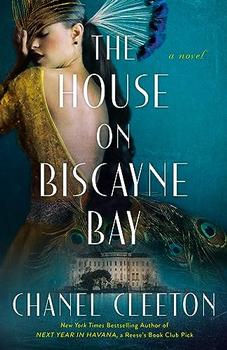
The House on Biscayne Bay
by Chanel Cleeton
As death stalks a gothic mansion in Miami, the lives of two women intertwine as the past and present collide.

The Funeral Cryer by Wenyan Lu
Debut novelist Wenyan Lu brings us this witty yet profound story about one woman's midlife reawakening in contemporary rural China.
Your guide toexceptional books
BookBrowse seeks out and recommends the best in contemporary fiction and nonfiction—books that not only engage and entertain but also deepen our understanding of ourselves and the world around us.