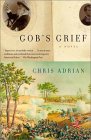
Chris Adrian explains the inspiration behind his first novel, Gob's Grief, how he manages to juggle writing with his medical studies, and why so many doctors seem to end up writing books.
What was the inspiration for Gob's Grief? Was it the period, the plot,
a character?
My brother died in an automobile accident in 1993, and shortly after that I
started a novel about an actor who plays a physician on a soap-opera. It bears
no resemblance to Gob's Grief but shares with it a title and a concern
with characters, living and dead, who try variously to understand, deny, accept,
or defeat their mortality. The novel underwent many transmogrifications of plot,
character, and setting, some of them truly strange and even a little gruesome,
before a friend introduced me to Mrs. Woodhull, and Mrs. Woodhull introduced me
to a New York in the years after the Civil War. I credit Mrs. Woodhull with
saving what was otherwise doomed to be a failed effort and probably a lifelong
source of misery for the author. I think I can safely call her and her time the
inspiration for the book, while the events in my life that required me to write
this novel are perhaps best called something else that connotes less airy joy
and more unhappy obsession. I suppose I could call it the desperation, rather
than the inspiration, for the novel. In any case, I wanted to write a story
where somebody gets his brother back.
The novel features fascinating portraits of historical characters. Could you
discuss the accuracy of these characters and the research you did for the book?
Writing this book required a whole lot of research, especially because I was an
indifferent student of history when it was offered to me in high school and
college. I was fortunate to be able to live in Washington, D.C. for a summer
just before I started medical school, and spent many days and weeks in the
reading room at the Library of Congress learning about the people I wanted to
write about. Living in Virginia meant that there were a number of Civil War
battlefields within a day's driving distance. I visited the New York and
Washington, D. C. Historical Societies, and the Woodhull-Martin Archives in
Carbondale, Illinois. I listened to recordings of Union infantry drill calls and
recordings of recreation cannons and rifles being fired and hitting their
targets. I read New York papers for the days that are covered in the novel, and
had some heavy bouts of microfilm-seasickness. I read a book on the history of
underwear that turned out to be not so terribly useful after all.
It seems a little strange to me that I could have done years of research and yet
still produced a book full of such wild inaccuracies. The most obvious and
glaring of these are the liberties taken in replacing real characters with
imaginary ones--for instance, Gob and Tomo Woodhull for Victoria Woodhull's real
children, Byron and Zulu Maud. Maci Trufant replaced no actual person, but the
character of her father is based on a Universalist minister-turned-spiritualist
prophet named John Murray Spears. Spears really did build a machine that he
claimed filled up with a spiritual essence evacuated from the womb of his
devoted compatriot, a lady never named in any source I could find. Will Fie is
another fabrication not based on any real person. Yet I think I sinned worst in
the characters that are most closely based on their real life counterparts--Walt
Whitman, Mrs. Woodhull, and her sister. These people generally locate themselves
in time and space in the novel the way they did in real life, but their actions
and even their attitudes are not always meant to represent their actual lives.
I'm sure this is most true of Whitman, and I know that of all the historical
personages abducted into this novel he is the one who will turn longest and most
vigorously in his grave.
The Urféist is an intriguing, mysterious figure. Where did this character
come from?
The Urféist is a figure out of Irish mythology about whom I read in passing
while researching a story completely unrelated to this novel. I took the name of
the creature that adopts and teaches Gob after he leaves Homer from this
mythological entity. The word Urféist means original or ancient worm, beast, or
monster. The character of the Urféist is based on a creature that visited me
regularly in recurring nightmares when I was a kid. He always came in the
company of Count Chocula, the charming cereal vampire, and together they would
engage in various fiendish and cruel behaviors.
The novel's America is at once being destroyed and built and the description
seems both real and imagined. Could you comment on the America of Gob's Grief
?
For a long time I struggled to find an environment hospitable to the sort of
people I was trying to write about, a place and time where people obsessed with
death and largely ruined by grief would be perfectly at home. If I had paid any
attention at all in my tenth grade history class it might have occurred to me a
great deal earlier that America in the years after the Civil War was just such a
place. In the novel two of the characters talk of belonging to a sort of club
whose members have all had brothers die, and it seems to me that this club could
have had no greater American membership than at this time. There are some
patently weird and ridiculous concepts in the novel, but I feel comfortable
maintaining that the idea that three people, all brother-widows or
brother-widowers, could have found each other and plotted together against death
is not one of them. Still, as warped as I perceived that society to be by death
and grief, it was warped further and worse by my ignorant imagination. In
general, the America of Gob's Grief is about as close to the real America
of 1863-1873 as Mr. Potato Head is to a real potato.
I noticed that you're currently a medical student. There's a prominent
lineage of physician/writers. What do you think is the connection between
medicine and literature?
There are days when I think that the two entities or disciplines are entirely
immiscible and antagonistic, and others where they seem not just to complement
each other but to be, in a strange way, twin enterprises. I generally have more
of the former days than the latter, but I hope that will change as I grow up,
both as a writer and as a future physician. You make nobody better by sitting up
all through the night and making yourself into a wild-eyed caffeine fiend for
the sake of five new pages of manuscript--only five sentences of which actually
turn out to be worth anything--and then subsequently sleeping through anatomy,
leaving the dirty cadaver work to your innocent classmates. Poetry, while it
probably does not actually do nothing in general, does nothing (to my knowledge)
for a spastic colon. Yet it seems to me that good doctors and good writers are
both likely to be keen social observers, and that when you are doing good work
in medicine or in fiction you are making obvious previously unseen connections.
A friend who is superior to me both as a writer and a person has proposed that
compassion is composed of elements of curiosity, imagination, and devotion; if
this is true than I think it could be argued that the arts of medicine and
literature rest on a foundation at least partially shared. As for the lineage of
physician/writers, some of them are my heroes and some of them make me sad. I
hope, in any case, not to follow what seems to be the sensible trend of leaving
one practice for the other. When people ask me which I would rather give up,
writing or medicine, it's like being asked which eye I'd prefer to have poked
out with a spoon: neither, and please use a fork.
What's next for you with respect to your writing career?
I've been plagued by an idea for a story for the past couple of years. It's
something for which I nearly abandoned Gob's Grief, when the going got
particularly miserable with that novel. But this new thing is (to my mind) quite
blasphemous and not just a little bit stupid, and whenever I work on it I always
seem to narrowly miss having bad accidents with buses or big dogs or the ocean,
so I will probably proceed cautiously and very slowly with it, if at all.
Meanwhile, I've been working on some little stories. Presently I'm trying to
finish something about submarines.
Interview by Michael Johnson, 2001. First published in Bold Type. Reproduced by permission of Random House publishing.
Unless otherwise stated, this interview was conducted at the time the book was first published, and is reproduced with permission of the publisher. This interview may not be reproduced or reprinted without permission in writing from the copyright holder.

Michael Cunningham is a novelist, screenwriter, and educator. His novel The Hours received the PEN/Faulkner Award and the Pulitzer Prize for Fiction in 1999. He has taught at Columbia University and Brooklyn College. He is ... (more)
If you enjoyed:
Gob's Grief
Try:
Specimen Days
by Michael Cunningham

Named for Edgar Allan Poe, Edgar Lawrence Doctorow occupies a central position in the history of American literature. On a shortlist that might also include Philip Roth, Toni Morrison, John Updike, Saul Bellow, and Don ... (more)
If you enjoyed:
Gob's Grief
Try:
The March
by E.L. Doctorow
We recommend 14 similar authors


The House on Biscayne Bay
by Chanel Cleeton
As death stalks a gothic mansion in Miami, the lives of two women intertwine as the past and present collide.
The Stone Home
by Crystal Hana Kim
A moving family drama and coming-of-age story revealing a dark corner of South Korean history.

The Funeral Cryer by Wenyan Lu
Debut novelist Wenyan Lu brings us this witty yet profound story about one woman's midlife reawakening in contemporary rural China.
Your guide toexceptional books
BookBrowse seeks out and recommends the best in contemporary fiction and nonfiction—books that not only engage and entertain but also deepen our understanding of ourselves and the world around us.