
-
Your next favorite book
is waiting.

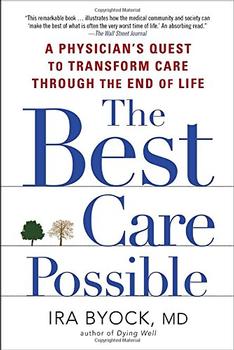
Ira Byock explains the philosophy behind palliative care and how, in many ways, it is a solution to the needless suffering many Americans experience before death.
Why did you decide to write this book?
Despite all the advances in medicine, far too many people who are seriously ill suffer needlessly and end up dying badly.
America's health care system is actually a disease-treatment system. People's health - including their physical, emotional, social and spiritual well-being, is often ignored in the quest to preserve life at all costs. In the process of battling disease, people often experience needless suffering, sometimes dying sooner than they should, sometimes lingering in a state of prolonged dying that few people would want.
Dying will never be easy. Similarly, caring for a loved one who is in the waning phases of life is inherently hard. All of us will eventually face the end of life, but neither dying nor caregiving has to be as hard as they are today.
It would seem irresponsible for me to keep what I have learned from patients and families and my experience as a doctor over all these years to myself. In a sense I am but a conduit, learning from patients and their families and passing along to my contemporaries the insights I have gained
What do you mean by "the best care possible?"
When we or someone we love becomes seriously ill, we all want the best care possible for them. Even in our culturally diverse society and despite the highly sensitive nature of the topic, receiving "the best care possible" is one thing on which everyone agrees. Doctors also want to provide the very best care for the people they serve.
But when it comes to illness and dying, one size does not fit all. What is just right for one person, might be utterly wrong for another. And optimal treatment for an early stage of illness, might be ill-advised later on.
Some things are clear: the best care is medically excellent, as well as highly personalized. In addition to bringing state-of-the-art science to bear, the best care must be consistent with the ill person's values and preferences, as well as the needs and concerns of the person's family.
It may all sound like a tall order, but I know it is possible to deliver on this vision. Day in and day out, our Palliative Care team at Dartmouth-Hitchcock Medical Center strives to do just that - and with some success.
It is not easy, and palliative care certainly isn't fancy, in comparison to high-tech new treatments for cancer or cardiac disease, but it is effective. The best care typically involves careful planning and communication, meticulous attention to people's symptoms and emotional needs, support for families in caregiving, coordination of appointments, as well as crisis prevention and development of management plans. It is ongoing, honest, and forward thinking. The best care extends beyond treating disease and people's pains to include extending help with the difficult but normal tasks of adjusting to the progressive changes and strains of illness and demands of completing one's life.
What is palliative care, and how is it different from hospice?
Palliative care is an inter-disciplinary team-based approach to people living with serious illness which responds to their physical, emotional, social and spiritual needs and seeks to improve quality of life for the person as well as his or her family. Hospice is the oldest and most familiar form of palliative care, which is intended to serve people who are dying. In the United States, most hospice care is delivered in people's homes.
Every time health care reform is discussed, there is concern that if the government is involved it will lead to things like "death panels." Should people be worried?
People are scared to death of dying. Either they fear dying prematurely because their lives are devalued by doctors or by our consumer-oriented society, or they fear being kept alive "like a vegetable" beyond any hope of being able to engage in or enjoy live. The fear of government death panels is another indication of the distrust that people have in doctors and nurses, and the hospitals in which we practice.
The best thing to do with one's fears is to write down what you think you would want - or not want - if you became seriously ill and couldn't speak for yourself. Who would you want to speak for you? What would you hope that person would do - either lean toward aggressive treatments to save and preserve your life or allow you to die gently? Making it formal - by completing an advance directive (often called a Living Will or Power of Attorney for Health Care) you can give the people you love authority to make decisions for you.
In addition to giving the people you choose authority, advance directives can decrease the burden that relatives and friends feel in making decisions when you are too ill to do so for yourself.
You have mentioned America's health care system being a disease-treatment system. How do you think we can improve to make it a preventative-based system?
We have to expand the focus on American health care to include not only injuries and diseases, but also the people who live with them - as well as the families of those who are ill.
Beyond the pathophysiology of injury and disease and physician and pharmacological aspects of treatments, we can attend to distress that is emotional, interpersonal and social, and even spiritual in nature - and we can strive to improve people's sense of well-being.
We should prevent injuries and disease to the extent possible, but we must also prevent complications and avert crises among people with chronic health conditions. Secondary prevention could improve quality of care and life for people in fragile health while decreasing health care costs. Secondary prevention also extends to preventing crises and stress-related illnesses among family caregivers.
Unless otherwise stated, this interview was conducted at the time the book was first published, and is reproduced with permission of the publisher. This interview may not be reproduced or reprinted without permission in writing from the copyright holder.
Dr. Erica Brown is a writer and educator who works as the scholar-in-residence for the Jewish Federation of Greater Washington. She is the author of Inspired Jewish Leadership, a National Jewish Book Award finalist, and a ... (more)
If you enjoyed:
The Best Care Possible
Try:
Happier Endings
by Erica Brown

Atul Gawande, MD, MPH, is a surgeon, writer, and public health researcher. He practices general and endocrine surgery at Brigham and Women's Hospital. He is Professor in the Department of Health Policy and Management at ... (more)
If you enjoyed:
The Best Care Possible
Try:
Being Mortal
by Atul Gawande
We recommend 11 similar authors







Harvard is the storehouse of knowledge because the freshmen bring so much in and the graduates take so little out.
Click Here to find out who said this, as well as discovering other famous literary quotes!

Can you name the title?
Test your book knowledge with our daily trivia challenge!
Your guide toexceptional books
BookBrowse seeks out and recommends the best in contemporary fiction and nonfiction—books that not only engage and entertain but also deepen our understanding of ourselves and the world around us.
