In two separate interviews, one video, one text, John Wray discusses Lowboy, and the challenges of writing a book while riding on the subway.
An interview with John Wray about Lowboy
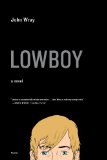
How does this differ from your earlier work? Although they differ from each other tremendously, my first two novels could both be categorized as historical, if one felt like applying labels: this time, I wanted to write as contemporary a story as possible, and to tell it as simply as possible. A few years ago, I came across an article in an Australian newspaper, about a manhunt for an escaped prisoner whose antipsychotic medication was wearing off by the hour, and I felt drawn to the subject matter immediately. The material then determined the style and tone—as straightforward and crystalline as possible—the way strong material tends to do.
Why the change? I’ve always admired film directors, like Stanley Kubrick or Billy Wilder, who could go from directing a thriller to a period piece to a romantic comedy without missing a step. Also, I’ve resisted drawing too directly from my surroundings and personal history in the past, and I wanted to investigate that resistance, to challenge it a little. So I put much more of myself, and of my family and certain childhood memories, into the book. The result makes me somewhat uncomfortable now, but it undoubtedly helped the novel.
You actually wrote this book on the subway. Why? What was that experience like? My reasons for writing on the subway were simultaneously practical and romantic: I liked the idea of being in constant motion as I worked, and also, of course, of spending as much time as possible in the environment and under the conditions I was writing about. But at the same time, I needed a place to work that was cut off from temptations like the internet and the presence of my girlfriend, who works at home. Also, it only cost four dollars a day—two if I never left the subway!
It turned out to be harder than I’d thought to concentrate on the trains, and for the first few weeks I was also hampered by my self-consciousness, which almost approached stage fright on certain days. But there are scenes in Lowboy that would never have been written if I hadn’t found myself in certain MTA stations, and many of those are my favorites in the novel. Rockefeller Center, for some reason, was especially fertile ground, and so was the out-of-service old City Hall station on the 6 line, which I snuck into on several occasions.
Lowboy is a paranoid schizophrenic. How does one write about mental illness in novel? How do you get it right? Attempting to inhabit the consciousness of a schizophrenic was without a doubt the most difficult thing I’ve ever tried in fiction. I was helped, to some degree, by the fact that I’ve always been interested in mental illness, and by the fact that I’ve come into close contact, in my life, both with schizophrenia and manic depressive disorder; but writing from the point of view of a sufferer—and, above all, writing in a way that neither reduced the condition to a set of clinical symptoms, nor amplified it into the kind of caricatures of insanity that are so rampant in our culture—was a hugely daunting balancing act. What saved me, I think, was my decision to treat Will as a boy struggling with a set of conditions, one of which happened to be schizophrenia, rather than as a schizophrenic first and foremost. That tends to be how schizophrenics view themselves.
You touch on a number of themes—global warming, the perils of schizophrenia, a culture of violence—in Lowboy. What brought you to them? One of the great privileges of being a writer—and, specifically, of being a novelist—is the opportunity to target one’s most acute anxieties in one’s work, and to tease a portion of them out into the open, if not exorcise them completely. My last novel, Canaan’s Tongue, was a deliberate attempt to channel my dismay and disgust at the Bush administration in some useful direction, and, to my great surprise, it actually helped me to cope. Will Heller’s anxieties and visions in Lowboy are very much my own (albeit—I hope—in heightened, intensified form), and I’m banking on the trick to work a second time. So far, so good.
Unless otherwise stated, this interview was conducted at the time the book was first published, and is reproduced with permission of the publisher.
This interview may not be reproduced or reprinted without permission in writing from the copyright holder.
All the books below are recommended as read-alikes for John Wray but some maybe more relevant to you than others depending on which books by the author you have read and enjoyed. So look for the suggested read-alikes by title linked on the right.
How we choose readalikes
A graduate of Rutgers College, Junot Diaz is the author of Drown and The Brief Wondrous Life of Oscar Wao which won the John Sargent Sr. First Novel Prize, the National Book Critics Circle Award, the Anisfield-Wolf Book ...
(more)
Fernanda Eberstadt was born in New York City on November 10, 1960. Her maternal grandfather was the poet Ogden Nash. She is the daughter of the photographer and psychotherapist Frederick Eberstadt, who lives in New York City....
(more)
BookBrowse seeks out and recommends the best in contemporary fiction and nonfiction—books that not only engage and entertain but also deepen our understanding of ourselves and the world around us.