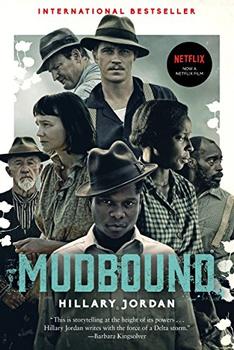
Two interviews with Hillary Jordan; first a video interview in which she discusses the connection between her most recent novel, When She Woke and Nathaniel Hawthorne's The Scarlet Letter, and a written piece in which she talks about her debut novel Mudbound, winner of the prestigious Bellwether Prize.
This page includes two interviews with Hillary Jordan; in the video below, she discusses the connection between her second novel, When She Woke and Nathaniel Hawthorne's The Scarlet Letter, and in the written piece beneath, she talks about her novel Mudbound, winner of the prestigious Bellwether Prize.
See also the reading guide page for When She Woke where you'll find another Q&A.
An interview with Hillary Jordan on her latest novel, When She Woke
Hillary Jordan discusses her debut novel, Mudbound
What inspired you to write Mudbound?
I grew up hearing stories about my grandparents' farm in Lake Village,
Arkansas. It was a primitive place, an unpainted shotgun shack with no
electricity, no running water and no telephone. They named it "Mudbound" because
whenever it rained, the roads would flood and they'd be stranded for days.
Though they'd only lived there for a year, my mother, aunt and grandmother spoke
of Mudbound often, laughing and shaking their heads by turns, depending on
whether the story in question was funny or horrifying. Often they were both, as
Southern stories tend to be. I loved listening to them, even the ones I'd heard
dozens of times before. They were a peephole into a strange and marvelous world;
a world full of contradictions, of terrible beauty. The stories revealed things
about my family, especially about my grandmother, who was the heroine of most of
them for the simple reason that when calamity struck, my grandfather was
invariably elsewhere.
To my mother and aunt, their year on the farm was a grand adventure; and indeed,
that was how all their stories, even my grandmother's, portrayed it. It was not
until much later that I realized what an ordeal that year must have been for her
- a city-bred woman with two young children - and that, in fact, these were
stories of survival.
I began the novel (without knowing I was doing any such thing) in graduate
school at Columbia. One of my teachers asked us to write a few pages in the
voice of a family member, and I decided to write about the farm from my
grandmother's point of view. But what came out was not a merry adventure story,
but something darker and more complex. What came out was, "When I think of the
farm, I think of mud."
If Mudbound was indeed a true place, how much of the story is based on fact?
The basic premise is true: My grandfather decided to move the family from
the city (Dallas, in reality) to the farm in 1946. Like Henry in the novel, he
wanted to be near his recently widowed sister, whose husband had committed
suicide. And too, my grandfather yearned to be a farmer. He was a native
Mississippian; reverence for the land was bred into his bones.
My grandmother had never seen the property, and I can only imagine how she felt
when she arrived to discover she would be living and rearing her two small
children (my mother and aunt were three and six, respectively) in such a
primitive place. But Nana was a woman of her time, obedient to her husband's
wishes, and so she made the best of it. My grandfather's brother, Bobby, came to
live with them, followed by her cantankerous father-in-law, and she cooked and
cleaned uncomplainingly for all of them. Like Laura in the novel, my grandmother
was a singer, and the songs she sang were indicative of her mood. "Rock of Ages"
was a frequent refrain on the farm, and - when things got really bad - "Were You
There When They Crucified Our Lord."
My grandparents also had black and white (as well as Mexican) sharecroppers on
the farm, and a black maid who helped with the housework.
And there reality ends, and fiction begins. I started with actual people and
events, but the more I wrote, the more the characters insisted on being
themselves, and the more trouble they got themselves into. Murder, lust,
betrayal, forbidden love - with fiction, all these things were possible, and oh
so beguiling to me as a writer.
Why did you choose to tell this story through six first-person voices?
Well, I wanted to make the process of writing my first novel as difficult
for myself as I possibly could.
That aside, I began by writing a short story in Laura's (my grandmother's) voice
and ended up with the Cliff Notes of a novel, squeezed into 35 pages. As I
thought about how I would unpack the story, I started experimenting with other
voices. Jamie's came first. I woke up in the wee hours, typed five pages about
the flood and went back to bed. It wasn't until I turned on the computer the
next morning and saw the pages on the screen that I remembered having written
them. Florence's voice was next. She poured out of me, though it took me a while
to get the dialect right. Then Henry, who was stubborn and difficult, and Hap,
who was a talker from the beginning. Ronsel didn't even exist until I saw a PBS
documentary called The Rise and Fall of Jim Crow. There was a segment
about the 761st Tank Battalion - their heroism and the discrimination they
endured. I knew right then that Florence and Hap had a son and that he was in
that battalion, though I had no idea how central he would become to the story.
Was it difficult for you to write in the voices of African American
characters?
Yes, but no more difficult than it was to write in the voices of men, of
soldiers, of farmers, of mothers, of devout Christians, of desperately poor
people with little education, of bigots or of an alcoholic - none of which I am,
and all of which I had to embody convincingly.
How would you answer those who might say that's not something a white writer has
any business doing?
In the stories I grew up hearing, black people were always in the background
- where African-Americans in the Jim Crow South were thought to belong. I
decided to put my black characters front and center, and to let them answer the
ugliness of Jim Crow in their own voices. Still, I was a little afraid. I knew I
would be excoriated (and rightly so) if I got it wrong. A number of well-meaning
colleagues said things to me like, "You know, even Faulkner didn't write about
black people in the first person." But ultimately, I decided that letting my
African-American characters speak was the only way to give them a small measure
of justice.
Also, from an artistic point of view, I think it's nonsense to tell a writer,
"You can't write about X because you're Y." If writers didn't make leaps into
existences other than our own, we wouldn't have Madame Bovary or Moll
Flanders or Jane Eyre or half of literature. Instead, we'd have a
whole lot of tedious books about lonely, neurotic types with writer's block and
knotted shoulder muscles. At the time I began Mudbound, I was a single
woman dating and struggling to survive in New York City - and how many more
novels do we need on that subject?
Your manuscript won the prestigious Bellwether Prize, judged by Barbara
Kingsolver. Tell us what it was like to get this news.
I sent off the second draft of the book in September 2005 with the $30 entry
fee, thinking, There goes thirty bucks. Then I heard in January that I
was one of a dozen semi-finalists, and I thought, Well, I was in the top
twelve anyway. A couple of months later I found out I was one of three
finalists, and I thought, Hey, at least I got close. Then, the night
Barbara called, she didn't identify herself right away, and I thought she was a
telemarketer. I was pretty un-cordial. I was about to hang up on her when she
said, "This is Barbara Kingsolver, and I'm calling to tell you that you've won
the Bellwether Prize."
I responded with the immortal words of a beauty pageant contestant: "Oh my God!"
Writers often say it took them many years and permutations to arrive at the
final version of their first novel. How long have you been working on
Mudbound?
About seven years, or was it seventy? I was putting myself through graduate
school, supporting myself in the city and frankly, doing a lot of dithering. My
best friend, James Cañón, was also struggling to finish his first novel (he and
I met at Columbia and were each other's primary readers while writing our
books). So we made a bet: whoever didn't finish his/her first draft by April 1,
2005, would have to pay the other the unthinkable sum of $1,000, plus endure a
lifetime of daily taunting and shame. I cut back my freelance ad work and
focused on my writing. I finished on time, and so did James.
Et voilà - two published novels!
Is there a particular character in Mudbound that you side with the most
or feel most sympathetic toward?
I started by identifying the most with Laura, for obvious reasons. But as
the others' voices developed, I became enamored with each of them in turn. Henry
was the hardest to love (and to write), but he won me over in the end. Ronsel
has the last word, so I suppose you could draw some conclusions from that.
Without giving too much away, the conclusion of your novel is unforgettably
powerful. Did you know how the book would end when you first began writing it?
I never had an outline for the novel; I wrote it very much as it came to me,
or it came to me as I wrote it - I'm not sure which. I struggled for months to
come up with a conclusion I could write towards. And then one night, it was just
there in my head. I called up James, and I said, "I know what happens in the
last big scene." When I told him, all the hairs rose up on my arms, and I knew I
really had something.
Writing the scene was wrenching. I had terrible nightmares for weeks. Enough
said.
Unless otherwise stated, this interview was conducted at the time the book was first published, and is reproduced with permission of the publisher. This interview may not be reproduced or reprinted without permission in writing from the copyright holder.

Margaret Atwood was born in 1939 in Ottawa, and grew up in northern Ontario and Quebec, and in Toronto. She received her undergraduate degree from Victoria College at the University of Toronto and her master's degree ... (more)
If you enjoyed:
When She Woke
Try:
The Heart Goes Last
by Margaret Atwood
Russell Banks was raised in New Hampshire and eastern Massachusetts. The
eldest of four children, he grew up in a working-class environment, which has
played a major role in his writing.
Mr. Banks (who was the first in his...
(more)
If you enjoyed:
When She Woke
Try:
Lost Memory of Skin
by Russell Banks
We recommend 31 similar authors

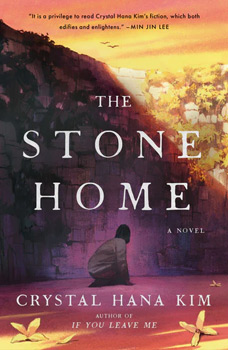
The Stone Home
by Crystal Hana Kim
A moving family drama and coming-of-age story revealing a dark corner of South Korean history.

The House on Biscayne Bay
by Chanel Cleeton
As death stalks a gothic mansion in Miami, the lives of two women intertwine as the past and present collide.

The Funeral Cryer by Wenyan Lu
Debut novelist Wenyan Lu brings us this witty yet profound story about one woman's midlife reawakening in contemporary rural China.
Your guide toexceptional books
BookBrowse seeks out and recommends the best in contemporary fiction and nonfiction—books that not only engage and entertain but also deepen our understanding of ourselves and the world around us.