
-
Your next favorite book
is waiting.

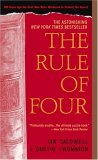
Ian Caldwell & Justin Thomason discuss The Rule of Four, their co-written debut intellectual suspense novel that's been described as 'Dan Brown by way of Donna Tartt and Umberto Eco'.
The novel centers on a real Renaissance text, The Hypnerotomachia Poliphili;
a book that is fairly obscure. Explain how you discovered this book and why
you choose to develop your story around it.
We owe it to a Princeton seminar entitled "Renaissance Art, Science, and
Magic." Ian’s final paper for the seminar dealt with a 1499 text entitled Hypnerotomachia
Poliphili, one of the most beautiful and valuable books of early Western
printing, and one that has divided scholars for years over its meaning and the
identity of its author. By the time the research paper was finished, we were
already planning to spend the summer writing an intellectual suspense novel
together. The mystery of the Hypnerotomachia supplied a perfect
starting point, and before long we had hatched a "solution" to the
book’s mystery that became the centerpiece of the plot.
You seamlessly blend fact and fiction throughout the novel. For example,
Savonarola is a real historical figure, about whom much is known, but what of
Francesco Colonna, the author of the Hypnerotomachia? How much is
really known about him and how fact-based is your portrait of him?
Oddly enough, scholars don’t even agree that the author of the book was
Francesco Colonna, despite the internal evidence of the text that he was. As
many "alternate" authors have been proposed for the Hypnerotomachia
as have been proposed for Shakespeare’s plays. To further complicate
matters, there are actually two Francesco Colonnas who may have written the
book, and both are shadowy figures. One was a Dominican monk in Venice, about
whom scattered Church records remain. The other was from the powerful Colonna
dynasty in Rome, and though much is known about other members of his family,
relatively little is known about Francesco. The Rule of Four tries to
remain as faithful as possible to the biographies of the contending Francescos,
but once Tom and Paul begin to decipher the Hypnerotomachia, they
discover a (fictional) side to the Roman Francesco Colonna that no one had
previously known.
Are secret codes really buried in the text of the Hypnerotomachia?
Yes. The disagreement among scholars is simply, how many? One of the Hypnerotomachia’s
mysteries is that its author never explicitly gives his name, but his identity
seems to be revealed when the first letter of every chapter is connected to
the next: the letters form the Latin message "Poliam Frater Franciscus
Columna Peramavit," meaning "Brother Francesco Colonna Loved Polia
Tremendously." (Polia is the name of the main female character in the Hypnerotomachia.)
In addition to this hidden acrostic message, the entire text of the book is
written in a hybrid of languages that was considered gratuitously complex even
in its own day. When these facts are combined with the strangeness of certain
elements in the story – the detailed attention to the dimensions and
features of buildings the protagonist sees, not to mention the protagonist’s
sexual feelings toward those buildings – it’s easy to see why some readers
believe there must be a hidden subtext.
What is a Rule of Four?
When Tom and Paul decipher the Hypnerotomachia, they find that the
author, Francesco Colonna, refers to a "Rule of Four" that will be
necessary to unlock the final portion of the text. The Rule appears to be
related to a set of four cardinal directions and distances found in a diary
that surfaces at the beginning of the novel. But Tom and Paul struggle to
understand how Francesco Colonna intended the Rule to be used. In a different
sense, the title The Rule of Four alludes to the friendship of the
novel’s four protagonists as they enter their final days of college
together.
The novel is about art, history, religion and scholarship, but it’s also
very much about friendship. Explain.
In a more transparent way than the Hypnerotomachia itself, The Rule
of Four uses academic disciplines and scholarly obsession as vehicles to
explore human relationships. If the backbone of the novel is the deciphering
of the Hypnerotomachia, then the novel’s soul is the story of friends
and lovers coming to terms with the end of innocence. The Renaissance text is
sometimes a mirror, and sometimes a foil, for the decisions and changes that
accompany the approach of adult life.
Dusty, you’re a trained physician and Ian you’re a historian, why write
a novel? And why together?
Out of consideration to real physicians and real historians, we’re
actually just two writers who’ve had to spend the past few years wearing
different hats. In fact, when we began The Rule of Four, we were just
two college grads who decided the first thing we wanted to do in the "real
world" – before we had to tackle jobs and medical school – was satisfy a
lifelong itch to write. We caught the bug when we met as eight-year-olds, and
in the fourteen years that followed, we got used to being co-authors, whether
of third-grade class plays or of high-school graduation speeches. Writing –
and writing together – just seemed natural. If it hadn’t, we couldn’t
have stuck with The Rule of Four for six years.
Explain the joint writing process.
It’s changed more than once since we began writing The Rule of Four
in 1998. These days we brainstorm ideas, scene structures, and character arcs
together over the phone; then one of us drafts a chapter and emails it to the
other, who revises it. Other than the first three months after graduation,
when we wrote side-by-side in Ian’s parents’ basement, we’ve spent the
past six years hundreds of miles apart, relying heavily on phone calls and
emails to make co-writing possible.
In a starred review, Publishers Weekly said about your novel "think Dan Brown by way of Donna Tartt and Umberto Eco." How do you feel
about this comparison?
We’d be lying if we said we weren’t thrilled; it’s hard to think of
better company. The Da Vinci Code wasn’t published until after we’d
finished The Rule of Four, but The Secret History and The
Name of the Rose were both inspirations to us back in 1998 when we started
writing.
Ian, you went to Princeton and Dusty you went to Harvard. Why did you
decide to set the novel at Princeton over Harvard?
At the time, in the wake of movies like "Good Will Hunting" and "With Honors," Harvard seemed overdone. Though we were reading Sylvia
Nasar’s book during the summer we began The Rule of Four, we had no
idea "A Beautiful Mind" would be made into a film three years later, with
Princeton in a starring role. Even if we’d known, though, our decision
would’ve been the same. Princeton offered a tradition of undergraduate
writing, from Fitzgerald’s This Side of Paradise to Edmund Wilson’s
turn on the staff of the Nassau Literary Review, which gave us hope.
It’s been suggested that most first novels are really thinly veiled
autobiography. Is this at all true about The Rule of Four?
Fiction in general seems to be a mixture of autobiography and wish
fulfillment, and The Rule of Four is no different. In the autobiography
category we would place many of the cosmetic details of life at Princeton,
much of the research into the Hypnerotomachia, and the underlying
preoccupation with friendship and love. In the wish-fulfillment category we
would place writing a senior thesis as groundbreaking as Paul’s, and maybe,
on a bad day, wanting a professor or two to turn up dead.
What’s next?
We’re at work on our next co-written book. Now that we’re both able to
focus completely on our writing, we look forward to finishing it in a lot less
time than The Rule of Four took!
Unless otherwise stated, this interview was conducted at the time the book was first published, and is reproduced with permission of the publisher. This interview may not be reproduced or reprinted without permission in writing from the copyright holder.

Dan Brown is the author of numerous #1 international bestsellers, including Origin, Inferno, The Lost Symbol, The Da Vinci Code, Angels & Demons, Deception Point, and Digital Fortress. (more)
If you enjoyed:
The Rule of Four
Try:
The Da Vinci Code
by Dan Brown

David Czuchlewski studied English at Princeton University under Joyce Carol Oates, and later studied medicine at Mount Sinai School of Medicine. He has published two books - The Muse Asylum and Empire of Light. (more)
If you enjoyed:
The Rule of Four
Try:
The Muse Asylum
by David Czuchlewski
We recommend 10 similar authors



In war there are no unwounded soldiers
Click Here to find out who said this, as well as discovering other famous literary quotes!

Can you name the title?
Test your book knowledge with our daily trivia challenge!
Your guide toexceptional books
BookBrowse seeks out and recommends the best in contemporary fiction and nonfiction—books that not only engage and entertain but also deepen our understanding of ourselves and the world around us.
