
-
Your next favorite book
is waiting.

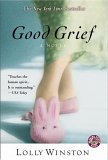
Can grief be categorized into five stages? Lolly Winston, author of the debut novel, Good Grief, think so, but the stages aren't as neat and tidy as books lead you to believe.
Okay, the question on everyone's mind: are you a
widow?
No.
Then why did you decide to write about grief?
My father died when I was 29 and four years later my mother died. The day that
my dad died I went out and bought a bathmat and a new lamp. Grief didn't hit me
for a while. I even found myself resenting the mourners at our house. How could
they accept his death so readily? I found grief like charging something on a
credit card--you pay later, with interest. Months after my father's death I
started breaking down. I remember sitting at my desk at work one day, unable to
pick up my pencil. Grief and depression became disabling. I was single at the
time, and I'd lost the person whom I was closest to. My father and I used to
talk on the phone every Sunday--about politics, basketball, whatever. After he
died I had the overwhelming urge to just call him up. I wanted to tell him that
Johnny Carson went off the air and the Berlin Wall came down. As I started to
come out of my funk, I wanted to write about all of that that--about the messy,
quirky aspects of grief.
Did you ever feel presumptuous writing about the death of a spouse when you
had never had that experience? What kind of research did you do to ensure that
you were realistic?
At times, yes. I wanted to write about grief, but I felt that the plot of the
story had to be about something other than the loss of a parent, which is quite
common. I wanted to dig deeper. By the time I started writing the book I was
married, and so I tapped into my worst fear--the death of my spouse.
For research I clipped newspaper and magazine articles, and I read Dr. Joyce
Brothers' lovely, insightful book called Widowed. I also found Andrew
Solomon's book on depression, The Noonday Demon, to be helpful. It is a
haunting book on the anatomy of a depressive breakdown.
You've taken the five stages of grief and turned them on their head. Why?
What do you think are the biggest misconceptions about grief?
The five stages of grief set forth by Elisabeth Kubler-Ross in her book On
Death and Dying--Denial, anger, bargaining, depression and acceptance--are
actually the stages that a terminally ill person goes through. She wrote her
book to help family and healthcare workers better understand the terminally ill.
I think her outline of the stages is brilliant and helpful to people. Over time
these stages have been assigned to the grieving process, which makes sense. But
it seems important to point out that grief is messy, and different for each
person. You might go through five stages in five minutes, twice a day, for three
years. Or you might get stuck in one stage for a long time.
After my dad died I went to a luncheon and an older widowed woman who sat next
to me said, "it's never quite the same after someone dies, is it?" Somehow these
words were so comforting--it's never quite the same. I'll make it. Life will go
on, and I'll be okay, but it's never quite the same. You don't have to "get over
it."
Sophie is so funny. Which is even more surprising when you hear that the book
is about a young widow. Did you intentionally set out to write a funny book
about grief?
Well, my favorite books are novels that are dark and funny, such as The Bell
Jar and Lolita. To me, the mixture of humor and difficult subject
matter adds up to poignancy.
I incorporated details of my own grief into the story. For example, in the book,
Sophie has a dream that she runs into Ethan and he's in his hospital gown,
trying to find his way home. I had this dream about my dad. My dream logic
wanted me to tell him that he wasn't lost, he was dead, but I worried that I
might hurt his feelings, like telling someone they're overweight. It took
retrospect for me to realize that there's irony and even humor in loss, and I
wanted to explore that in a novel.
It took you five years to write Good Grief, during which 9/11 happened. All
of a sudden young widows are no longer an oddity. Did you think about that when
you were writing this?
September 11th and the weeks that followed were the one time that I truly
experienced writer's block. I did feel presumptuous writing about a widow. I
thought, "Who am I to write about this experience?" I was paralyzed, as I know
everyone must have been. But then grief seemed like an even more important topic
than ever, and slowly I went back to work.
Sophie doesn't idealize Ethan. She remembers that sometimes he was
insensitive, that he didn't always listen to her. At one point she says to her
grief partner's son, "Dead people never do anything wrong." Do you think people
have a difficult time remembering their lost loved ones the way they really
were-faults and all?
One Thanksgiving after my Dad died I was in the kitchen with friends and family
and we were arguing and I thought, "Oh! I wish Dad was here. He wouldn't be
criticizing the gravy. Everything would be better if he was here!" And I
realized that if he was there we'd be arguing with him too. He would have burned
something or drank too much or committed some kind of blunder. It occurred to me
that we idealize dead people. Suddenly they can do no wrong. I had to laugh at
myself for this.
Also, when I first started writing the book my writers group said, "This
marriage and this husband are too perfect." And they were right. You have to be
careful of over sentimentalizing a topic like this. So I gave Ethan flaws, and
gave the relationship flaws.
Sophie eats to comfort herself, and later on she cooks desserts to comfort
herself. Do you think women in particular turn to food for comfort? Do you think
there's some sort of genetic link on the X chromosome between sugar and comfort?
I'm not sure if it's gender related, but for some reason carbs and sugar seem to
be comforting. After all, where's the solace in broccoli?
One of my favorite short stories is "A Small, Good Thing," by Ramond Carver.
It's about a couple whose child is killed while riding his bike. At the end of
the story the man and woman end up in a bakery eating warm cinnamon rolls and
the baker says, "Eating is a small, good thing in a time like this." Of course
there's more to the story than that, but somehow everything is winnowed down to
the basics in times like these. I remember when my father was in the hospital
dying. I thought we'd have these great long philosophical conversations. But our
conversations went more like this: "Dad, would you like some Chap Stick?" A nod.
I dabbed some on for him. "Wanna watch the basketball game?" A nod, a smile. I
turned on the TV to the Detroit Pistons/Chicago Bulls game. He squeezed my hand,
smiled, closed his eyes, fell asleep. I watched the game.
Do you cook? And is there really such a thing as a Brie-and-porcini
cheesecake? (if so, can you include the recipe?)
Like Sophie, I was a failed waitress. I spilled food on patrons and broke wine
corks in half in the bottle and forgot who ordered what. I was a nightmare with
a tray. One day I came to work and the food and beverage manager said, "You work
in the kitchen from now on." The chef taught me to bake the desserts. After that
I had a number of jobs cooking and baking. After all, I was an English major.
I knew a woman in Silicon Valley who quit her corporate life to open a business
selling savory cheesecakes and so I cribbed that real-life detail. But there's
no brie and porcini recipe that I know of.
You live in Silicon Valley. Is it really like the way you depict it in the
book? And have you ever lived in Ashland?
My husband was a software engineer in the 1990s during the "boom" years in
Silicon Valley, which meant that he worked all-nighters and 36-hour weekends.
During those years, if you didn't have a sleeping bag and a toothbrush in your
cubicle, you weren't considered a team player. Family was low on the priority
list. I wanted to include some of that craziness in the story. Especially in the
face of cancer, it is pretty ridiculous to make software a priority over your
family.
I've never lived in Ashland, but I've gone to the Oregon Shakespeare Festival
for many years now, and I've written freelance travel and food pieces about the
area. OSF is a wonderful reparatory theater and they do a whole variety of plays
other than Shakespeare. It's just phenomenal, and the town is so pretty.
Did you worry about typecasting Marion as the difficult mother-in-law?
Well, Sophie needed a foil. She is struggling to be a good widow and she feels
like she's a terrible widow, so I wanted the proper upright polished widow to
offset her.
How did you come up with the character of Crystal? Did you consciously set
out to portray someone who was deeply flawed? What is your favorite
characteristic about Crystal?
I wanted a character other than a new man to come into Sophie's life and be her
"happily ever after." Also, I wanted that character to force Sophie to come out
of her self-absorbed shell and find that solace that lies in caring for others.
I missed Crystal the most when I finished writing the book. My favorite
characteristic of hers is that she always tells it like it is.
This is your first novel. Can you tell us how you actually wrote the book-did
you have the whole book planned in an outline, did you start with Sophie? How do
you go about writing?
Since college I've been writing short stories. Most of my jobs involved
writing-from copywriting, to editing, to public relations. In my thirties I
started writing and publishing essays, and then I wrote feature stories for a
living. But fiction was always my first love. Really, I just had the personal
goal of finishing a novel before I turned forty. Even if it was collecting dust
in a drawer somewhere when I was on my death bed, I just wanted it to be
finished. And so in the year before my fortieth birthday I took some time off
from freelancing and focused just on the book. I found my writers group and a
couple of fiction workshops really helped. It got me out of my office, and the
feedback was terrific.
What has been the biggest surprise about the response to Good Grief?
The nicest surprise is when men say they like the book. I think of myself as a
mainstream writer, rather than as a "women's fiction" writer. I want George
Clooney to read my book!
Unless otherwise stated, this interview was conducted at the time the book was first published, and is reproduced with permission of the publisher. This interview may not be reproduced or reprinted without permission in writing from the copyright holder.

Elizabeth spent her childhood moving home every three years - including living for brief periods in Egypt and Nigeria before moving to Guildford, York and Edinburgh.
After graduating from the University of Kent at ...
(more)
If you enjoyed:
Good Grief
Try:
Revenge Of The Middle-Aged Woman
by Elizabeth Buchan
Fannie Flagg's career started in the fifth grade when she wrote, directed, and starred in her first play, titled The Whoopee Girls, and she has not stopped since. At age nineteen she began writing and producing television ... (more)
If you enjoyed:
Good Grief
Try:
Standing In The Rainbow
by Fannie Flagg
We recommend 9 similar authors



When a true genius appears in the world, you may know him by this sign...
Click Here to find out who said this, as well as discovering other famous literary quotes!

Can you name the title?
Test your book knowledge with our daily trivia challenge!
Your guide toexceptional books
BookBrowse seeks out and recommends the best in contemporary fiction and nonfiction—books that not only engage and entertain but also deepen our understanding of ourselves and the world around us.
