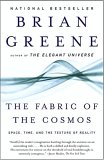
Brian Greene discusses The Fabric of the Cosmos, in which he translates cutting edge research into language the layman can understand.
Q: What would you say to people who think they are just not smart enough to
ever fully wrap their minds around the nature of the universe?
A: For most people, the major hurdle in grasping modern insights into the
nature of the universe is that these developments are usually phrased using
mathematics. But when the impediment of mathematics is removed and the ideas
themselves are rephrased in common language, they're not that hard to
understand. So, I say: give it a try--and most people do find that they grasp
much more than they expected.
Q: Is it a challenge, as a physicist and mathematician to write in a way
that everyone can understand?
A: It is a challenge, but for me its both a useful and exciting one. I
find that translating cutting-edge research into more familiar language forces
me to strip away extraneous details and zero in on the core ideas. Often, this
helps me to organize my own thoughts and has even suggested research
directions. And it's exciting to see ideas that are close to my heart and
those of other researchers in the field reach a wider audience. The questions
we are tackling are universal, and everyone deserves the right to enjoy the
progress we're making.
Q: What made you decide to follow The Elegant Universe and string theory
with an exploration of cosmology?
A: Well, I wouldn't say that The Fabric of the Cosmos is a book on
cosmology. Cosmology certainly plays a big part, but the major theme is our
ever evolving understanding of space and time, and what it all means for our
sense of reality. The Elegant Universe was a book about the search for a
unified theory, in which space and time were supporting characters. As I was
writing it, I almost had to keep space and time in check, as they so easily
could have taken over. In The Fabric of the Cosmos, I let them have free
reign--and space and time, with little effort, assumed the starring roles.
Q: You make some mind-boggling statements about the nature of time. Can you
elaborate on the difference between how physicists and the rest of us view
time?
A: Well, in day to day life, physicists view time in the same way that
everyone else does. And that makes it all the more surprising when we examine
how time appears in our current theoretical frameworks, because nowhere in our
theories do we see the intuitive notion of time that we all embrace. Nowhere,
for example, can we find the theoretical underpinnings for our sense that time
flows from one second to the next. Instead, our theories seem to indicate that
time doesn't flow--rather, past, present, and future are all there, always,
forever frozen in place. Moreover, we all sense that time has a direction
pointing from what we call past to what we call future. And much of what we
experience adheres fully to this "arrow of time" (e.g. eggs break
but they never unbreak, we remember the past but not the future, etc.). But as
familiar as this all is, explaining the origin of time's arrow using our
understanding of physics is no small task. And when we look at the problem
closely, it seems to require that we understand what conditions were like at
the birth of the universe. That is why I spend a good deal of time in The
Fabric of the Cosmos discussing cosmology.
Q: Doesn't that make it hard to catch a train?
A: It does, but it doesn't make for a good excuse--at least not more than
once.
Q: You discuss some seemingly simple things that turn out to be quite
complex beneath the surface, like water sloshing around a spinning bucket. Can
you explain?
A: Well, physics is ultimately about explaining what we see and
experience. And some things that might seem mundane--like a bucket of spinning
water--actually tap into some deep mysteries. As I describe in the book,
Newton himself realized that a bucket of spinning water raised surprisingly
delicate questions about the nature of space--whether or not space is a human
abstraction or a real physical entity. It's a question we are still pondering
today.
Q: What's the most startling and unexpected revelation about the universe
that you have seen in your career as a physicist?
A: That's a tough question. Probably the growing belief, due largely to
string theory, that our universe may really have more than three space
dimensions. That possibility really blows my mind.
Q: You are one of the world's foremost experts on string theory. In your
new book you also talk about superstrings and branes, what exactly is the
difference?
A: Well, a superstring--like a very, very thin rubber band--is an object
with only one dimension, the dimension that extends along its own length.
Branes are simply objects with more dimensions. A two-brane has two dimensions
(like a disk or frisbee), a three-brane has three
dimensions (like a lump of clay), and the higher dimensional branes have more
dimensions (don't worry, I can't picture them either). The point is that
superstring theory was initially thought to only contain strings. But in
recent years, we've come to realize that these other, higher dimensional
objects--the branes--also have an important role in the theory.
Q: What are black holes and what do they tell us about the nature of
universe?
A: Black holes are regions of the universe in which so much mass has been
crushed to such a small size that the pull of gravity is enormous. So strong,
in fact, that if you get too close it is impossible to escape. Even a beam of
light that gets too close will be sucked in, explaining why black holes are
black--light can't escape their powerful gravitational grip. Black holes
provide theoreticians with an important theoretical laboratory to test ideas.
Conditions within a black hole are so extreme, that by analyzing aspects of
black holes we see space and time in an exotic environment, one that has shed
important, and sometimes perplexing, new light an their fundamental nature.
Q: You say that a particle on one side of the universe can influence the
action of a sister particle on the other side of the universe instantaneously.
Does this violate Einstein's statement that nothing can travel faster than the
speed of light?
A: It is a delicate question, but most physicists would say no. The
influence is such that no information can be sent from place to place at
faster than light speed, and many believe that's enough to avoid conflict with
Einstein's recognition that light sets a cosmic speed limit. I am among those
who take this point of view, but as I stress in the book, this issue--due to
remaining conundrums surrounding quantum mechanics--is not fully settled.
Q: How close are we to really understanding the nature of the universe?
A: Sometimes I think the final theory is just around the corner. Sometimes I
think such thoughts are naive. The bottom line is I don't know, but what we're
learning is so startling, that in a way it doesn't matter. When or if we reach
the deepest understanding, it will be a major moment for our species. But
until then, making progress at unraveling the cosmos is its own reward.
Q: What do you think of the new Matrix movie?
A: Liked the first one better--made you think more about what constitutes
reality. Second one had only a bit of that, and although the effects were
great, I just felt exhausted by the end.
Unless otherwise stated, this interview was conducted at the time the book was first published, and is reproduced with permission of the publisher. This interview may not be reproduced or reprinted without permission in writing from the copyright holder.


Stephen Hawking is the former Lucasian Professor of Mathematics at the University of Cambridge and author of A Brief History of Time which was an international bestseller. Now the Dennis Stanton Avery and Sally Tsui Wong-... (more)
If you enjoyed:
The Fabric of the Cosmos
Try:
The Universe In A Nutshell
by Stephen Hawking

Richard Holmes (born 1945) is an award-wining British author best-known for his biographical studies of major figures of British and French Romanticism.
He is a Fellow of The Royal Society of Literature and a Fellow of the ...
(more)
If you enjoyed:
The Fabric of the Cosmos
Try:
The Age of Wonder
by Richard Holmes
We recommend 5 similar authors






The Flower Sisters
by Michelle Collins Anderson
From the new Fannie Flagg of the Ozarks, a richly-woven story of family, forgiveness, and reinvention.
The House on Biscayne Bay
by Chanel Cleeton
As death stalks a gothic mansion in Miami, the lives of two women intertwine as the past and present collide.

The Funeral Cryer by Wenyan Lu
Debut novelist Wenyan Lu brings us this witty yet profound story about one woman's midlife reawakening in contemporary rural China.
Your guide toexceptional books
BookBrowse seeks out and recommends the best in contemporary fiction and nonfiction—books that not only engage and entertain but also deepen our understanding of ourselves and the world around us.