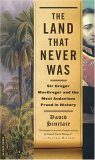
David Sinclair discusses his biography of Gregor MacGregor, a 19th century swindler who conned hundreds of settlers into buying land in a country that didn't exist - a fact they did not discover until they'd traveled half way round the world to Central America to claim their property.
How did you first hear about Sir Gregor MacGregor, and what made you
decide to write a book about him?
When I first heard the outline of the MacGregor story, I found it so
hard to believe that I felt it must be worth further investigation--and
that if it did turn out to be absolutely true, it would definitely deserve
a book. It came about at a New Year party, when I was living in Ireland. A
friend of mine, Desmond FitzGerald, who holds the ancient Irish title of
The Knight of Glin, told me that he had found among the family archives at
Glin Castle, in County Limerick, material relating to the involvement of
two of his ancestors with a certain General Sir Gregor MacGregor in a
sensational 19th century fraud. MacGregor had invented an entire country
in Central America. Not only had he sold land there to hundreds of people
in Scotland, and persuaded them to emigrate, but he had also floated a
£200,000 loan on the London capital market for the "government"
of this fictitious country. How had he gotten away with it? Desmond did
not know. What concerned him was whether his forebears had been part of
the plot, or simply among MacGregor's dupes. What struck me, however, was
that this sounded like the best story I had come across in more than 20
years of historical and biographical writing. And so it proved--a story of
war, politics, love, vanity, betrayal and an utterly amazing crime.
Incidentally, Desmond's ancestors turned out to be guilty of nothing but
astonishing naivety.
How has your long career as a journalist prepared you to write this
book?
I'm not the first author to suggest that journalism is the best
preparation you can have for the writing trade. That is particularly the
case with non-fiction. A journalist learns how to identify a good story,
and how to tell it in a way people will enjoy reading. Every story has
elements that are essential, and others that serve to decorate and
illuminate it. A good journalist develops the skills to get the balance
right, to inform, entertain--and perhaps to educate a little at the same
time, often without the reader noticing. What that means for me is that
history can always fascinate, and need never be boring. I'm interested to
see that many academic historians nowadays are trying hard to write their
books in a way that owes much to an intelligent journalistic approach.
Tell us about your research process for this book. Did it require an
archival dig? Did you have to go to Scotland?
Research, of course, is another thing for which the journalist is
professionally equipped. First, ask the right questions, then identify
what you have to do to obtain the right answers. MacGregor, as a fraudster
and lifelong impostor, did not leave much in the way of documentary
evidence of his extraordinary life. I started researching with one
50-year-old magazine article, giving the bare bones of the story. Then it
was a question of covering as many sources as might throw light on the
story. Some information could only be obtained by examining archives in
libraries and museums in Edinburgh and London, but much material on South
America, and the real inhabitants of Poyais, I found as a result of
patient examination of university and government sites on the Internet.
Then the breakthrough: not only did I turn up three books by people who
had been intimately involved with MacGregor, but I also managed to
acquire, through a British bookseller, the only copy in circulation of a
"guidebook" to Poyais, produced in 1822 with the intention of
enticing people to buy land in the non-existent country. That was
incredibly exciting, to hold in my hands one of the most important
elements in the fraud.
Why were the people who set out for Poyais so gullible?
The Poyais settlers were no more gullible than any other people, before
or since. Think of the South Sea Bubble, in the 18th century, or the Tulip
Mania long before that, or the dot-com hysteria of our own times.
Gullibility is the flip side of the creative human capacity to dream,
without which the species would never have achieved dominance in the
natural order. People are programmed to believe, to have faith, and to
take huge risks on the basis of that faith: I think it's part of our
natural survival mechanisms. The Poyais deception, and the many other
frauds and confidence tricks we can think of, illustrate both how easy it
is to exploit that faith and the dangers of people believing what they
want to believe, rather than considering what might or might not be true,
in pursuit of their dreams. That's partly what makes it such a great
story--its universality in terms of time and human experience.
Could a similar fraud be perpetrated today, or was it unique to the
period?
Similar frauds are being perpetrated today, though not on the same
scale. In Europe, many people in recent years have been robbed of their
life savings by crooked property companies offering homes in the sun that
do not actually exist. The unique feature of MacGregor's scam was that it
involved an entire country, something that could not happen today because
of the easy availability of information. What places Poyais firmly in its
period is the fact that large parts of the world remained unexplored or
little known, and it was not unusual for "new" territories
suddenly to be brought to the attention of people living thousands of
miles away. In the case of Poyais, it did correspond to a particular area
that could be identified on a map of South America, and a small part of
that area had once been settled by the British. There was no reason for
people to question the picture of the country carefully painted by
MacGregor, especially given his supposed status as a hero of the South
American wars of independence. Verifying his assertions, in an age of
still primitive communications, would have required significant effort,
expense and time.
Had you been around in 1823--and had you been a Scottish
immigrant--do
you
think you'd have set out for Poyais?
I'd like to think I would have been more skeptical than the thousands
of people who, either as immigrants or investors, fell for the Poyais
hoax. On the other hand, MacGregor's preparations were so meticulous and
convincing--the maps, the guidebook, the impressive land certificates, the
engravings of the countryside, the currency--that I can see it might have
been difficult to resist. And if I had been an impecunious younger son of
the gentry, or a farmer struggling to survive an agricultural depression,
or a soldier discharged from the army with little prospect of finding a
good job, or a poorly paid artisan in a grimy and unsanitary city, I might
well have decided to take the risk and opt for the bright, prosperous
future and healthful climate that Poyais appeared to offer the
adventurous.
You seem to have an affection for MacGregor, even though he defrauded
many, many people. How come? What were his redeeming qualities?
Like so many of Gregor MacGregor's contemporaries, I find it hard not
to be impressed by a man of such vision, energy and determination. You can
see from his story that he was intelligent, charming, and with something
of a capacity for greatness. His great flaw was an almost pathological
self-regard, which blinded him to the needs, feelings and qualities of
other people and turned them, so far as he was concerned, into fodder for
his vanity and ambition. His great tragedy was that his inability to
recognize the truth prevented him from realizing what could otherwise have
been a visionary dream in creating a new country. No, I wouldn't say I
have any affection for MacGregor: he was an unprincipled and sometimes
cowardly rogue who, in the end, bears the responsibility for the deaths of
hundreds of men, women and children who trusted him. But I do see him as
being another victim of his warped personality, so I have tried to be
even-handed in the book by revealing those qualities that attracted people
to him and, in some cases, inspired loyalty beyond reason.
Can you think of any present-day rogues as scurrilous as MacGregor? Or
have there been any others in history who stand out?
MacGregor is unique. There has never been a fraud as bold and
all-embracing as his. Others have come close, though, in terms of boldness
and methodical planning. One such, in our own times, is Konrad Kujau, who
so nearly succeeded with his forgery of Adolf Hitler's diaries, as did
Clifford Irving with his fake biography of Howard Hughes. The London toy
dealer Jeffrey Levitt lived a millionaire's life on the basis of huge,
well-organized frauds that included the sale of a toy train he claimed had
belonged to Tsar Nicholas II of Russia. Earlier, the hoaxer--one of several
plausible suspects--who claimed in 1913 to have unearthed the early
humanoid known as Piltdown Man had archaeologists fooled for 40 years. But
the longest-running fraud in history dates back to 765 AD, when a document
purportedly signed by the Roman Emperor Constantine was
"discovered." This ceded Rome and large parts of western Italy
to the Catholic Church, and although it was revealed as a fake in 1440,
the Church did not hand over the so-called Papal States to the Italian
government until 1929.
As you say in your Author's Note, "Money plays a central role in
this story." Do you think there's a business lesson in The Land That
Never Was?
As onetime editor of a financial newspaper, I think The Land That Never
Was is a great example of what I call the "principle of
perversity." In broad terms, this states that, the more outlandish
and unlikely the business proposition, the more excitement it will
generate in financial markets. Poyais was a country no one had heard of,
with no economic history, and yet, according to MacGregor, it was home to
rich merchants, a sophisticated banking and monetary system, and a capital
city whose architecture might rival Paris or London. How come? Nobody
asked the question. Instead, the market went into a frenzy of buying when
Poyais government bonds were offered, and the price soared. I think of the
18th century London company that raised hundreds of thousands of pounds in
capital on a prospectus that consisted largely of a plan to sell
handkerchiefs to South American natives; the railway companies of the 19th
century that grew fat on projects in places that could never have
supported railways; the dot-com bubble, when companies that never had the
slightest prospect of making profits attracted millions of dollars in
venture capital. Much has been written about the behavioral psychology of
markets--what about their tendency to utter irrationality?
What's your personal Poyais? Does everybody need one?
A personal Poyais? I don't think so. Forty years in the newspaper
business have made me wary of chimeras. Except, I suppose, that the
background to much of my life is France, a country that is not my own. But
that is a choice I've made not on the basis of a dream, rather for a
series of practical and philosophical reasons. France suits my pocket and
my style, and I find it reassuring to be at the heart of the broadest kind
of European culture. Nothing to do with the European Union, which does
little to help my personal circumstances (or those of anyone else for that
matter); more to do with feeling for a shared European history that is
often denied in England--though not in Scotland and Ireland. I doubt
whether a personal Poyais is necessary, but what is essential, for me, is
a willingness to take the plunge if a genuine Poyais appears on the
horizon.
Unless otherwise stated, this interview was conducted at the time the book was first published, and is reproduced with permission of the publisher. This interview may not be reproduced or reprinted without permission in writing from the copyright holder.

Frank W. Abagnale is one of the world's most respected authorities on forgery, embezzlement and secure documents. For over 35 years he has worked with, advised and consulted with hundreds of financial institutions, ... (more)
If you enjoyed:
The Land That Never Was
Try:
Catch Me If You Can
by Frank W. Abagnale

Pope Brock is a writer, teacher and DJ living in Arlington, Massachusetts. He is the author of three books: Indiana Gothic (Doubleday/Nan A. Talese), about the murder of his great-grandfather; Charlatan: America's Most ... (more)
If you enjoyed:
The Land That Never Was
Try:
Charlatan
by Pope Brock
We recommend 11 similar authors




The Flower Sisters
by Michelle Collins Anderson
From the new Fannie Flagg of the Ozarks, a richly-woven story of family, forgiveness, and reinvention.

The House on Biscayne Bay
by Chanel Cleeton
As death stalks a gothic mansion in Miami, the lives of two women intertwine as the past and present collide.

The Funeral Cryer by Wenyan Lu
Debut novelist Wenyan Lu brings us this witty yet profound story about one woman's midlife reawakening in contemporary rural China.
Your guide toexceptional books
BookBrowse seeks out and recommends the best in contemporary fiction and nonfiction—books that not only engage and entertain but also deepen our understanding of ourselves and the world around us.