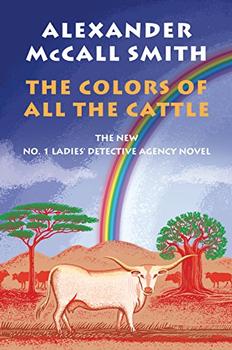
Alexander McCall Smith talks about Mma Ramotswe, a lady detective of 'traditional build', and the lead character of his delightful mystery series set in Botswana (The No.1 Ladies Detective Agency series); how he juggles his writing (of more than 50 books), with his job as a law professor, and still has time to play music with the 'The Really Terrible Orchestra'.
You have written more than fifty books (from specialist titles such as Forensic Aspects of Sleep to children's books, including The Perfect Hamburger). Was
The No.1 Ladies Detective Agency your first attempt at writing a mystery?
The No. 1 Ladies' Detective Agency is my first foray into this
territory, although I do not think of it as a mystery. I like to think of it as
a novel about a woman who happens to be a private detective. Mind you, I suppose
that makes it a mystery ... of a sort.
Your detective, Precious Ramotswe, is a wonderfully unique character—a
Batswana woman of traditional build who decides to become a professional private
detective. Is Precious based on someone that you knew when you lived in Botswana
or is she a creation of your imagination?
There is no particular person upon whom Precious Ramotswe is based,
but there is an incident. Years ago I was in Botswana, staying with friends in a
small town called Mochudi. A woman in the town wished to give my friends a
chicken to celebrate Botswana National Day. I watched as this
woman—traditionally built, like Mma Ramotswe—chased the chicken round the
yard and eventually caught it. She made a clucking noise as she ran. The chicken
looked miserable. She looked very cheerful. At that moment I thought that I
might write a book about a cheerful woman of traditional build.
Did you know immediately that the story of Mma Ramotswe would be the basis
for an entire series of novels?
No, I did not. What happened is that I became so fond of the character
that I could not let her go. To leave her where she was at the end of the first
novel would have been rather like getting up and leaving the room in the middle
of a conversation—rather rude.
It is rare for an author to explore the evolution from amateur sleuth to
professional detective, but one of the most appealing aspects of Precious's
character is that she doesn't always know what she's doing. In Tears of The
Giraffe (the sequel to The No1 Ladies' Detective Agency), she even sends away
for an instructional manual, Principles of Private Detection. What interests you
about "education of the detective"?
Mma Ramotswe sets up her agency without any relevant experience.
However, she does have intuition—in abundance—and that is very much more
important than anything she could learn from a book. In fact, the passages she
cites from The Principles of Private Detection are ultimately not particularly
helpful to her, the point being that a person without any training can achieve
great things if he or she has natural intelligence and ability. In many African
countries, including Botswana, people have great respect for books and for the
learning they contain. I would hope to point out that this should not obscure
the importance of real, practical wisdom.
Although Mma Ramotswe is confronted by greed, lust, dishonesty, and
murderous intent, these novels are rather optimistic and often humorous in tone.
How do you maintain this rather delicate balance?
> I think that many people living in Africa—in circumstances which are
sometimes quite difficult—maintain that balance themselves, and with great
dignity. I think that I merely reflect what is there in those fine people.
In the Precious Ramotswe novels, Botswana emerges as a vivid character and
a wonderful place to live. What do you hope that American readers will discover
about Africa while reading these novels?
I very much hope that American readers will get a glimpse of the
remarkable qualities of Botswana. It is a very special country and I think that
it particularly chimes with many of the values which Americans feel very
strongly about—respect for the rule of law and for individual freedom. I hope
that readers will also see in these portrayals of Botswana some of the
great traditional virtues in Africa—in particular, courtesy and a striking
natural dignity.
How have these books been received in Botswana? What about other parts of
Africa?
I was recently in Botswana and I was delighted to find that people
there liked the books. I was worried that they might have reservations about an
outsider writing about their society. No. They appear to like the way in which
their world is portrayed. I believe that they recognize themselves in them.
You were born in what is now known as Zimbabwe and you have also lived in
Botswana, the United States, and Edinburgh. In what ways have your international
travels informed your writing?
The fact that I have been all over the world means that I tend to use
a variety of locations for my work. I think it is important for a writer to
see other societies and attempt to understand them. Of course, you have to be
careful. It is easy to get things wrong. One might put palm trees in the wrong
place, for example in New York.
Do you see the Precious Ramotswe books within the context of the tradition
of the classic African novel of writers like Isak Dinesen and Chinua Achebe? Or
do you see them as a revamping of the mystery genre?
I think that these books might be difficult to put into any particular
tradition. They are obviously about Africa, but they are very different from the
works you mention. Some people say that they remind them of the novels of
that great Indian writer R.K. Narayan, which is very flattering, but I suppose I
can see the similarities in the world which his and my books portray.
Anthony Minghella, who has directed The English Patient and The
Talented Mr. Ripley recently optioned The No.1 Ladies' Detective
Agency to
be a major motion picture. Will you be involved in the production in any way?
I hope that this goes ahead as planned. They have shown me a script,
which I read with interest. They said that I could come and see the shooting,
one of these days. I shall stand well back and I suspect that I shall say
nothing.
The Precious Ramotswe books have a devoted following. Have you ever had
the opportunity to meet with the Mma Ramotswe fan club that is based in New
York? What question are you most frequently asked by your fans?
There seem to be many fans of the books in the U.S.A. I receive
wonderfully warm letters from American readers, which I greatly enjoy. As far as
New York is concerned, there is a splendid group of readers whom I met when I
was last there. They love Mma Ramotswe and she would love them too. They, like
many other readers, ask me when Mma Ramotswe and Mr J.L.B. Matekoni will
eventually get married. I must think about that.
Next spring, Pantheon Books will publish the fourth in the series of the
Precious Ramotswe novels. Will there be other books in the series as well?
I hope so. I am writing the fifth at the moment and I am thinking of
the sixth.
In addition to writing novels, you are also a professor of medical law at
Edinburgh University, and as if that wasn't enough to keep you busy, you also
conduct a symphony. How do you find the time to do it all?
I struggle to find the time to do things. I have many commitments, but
writing these books is such a pleasure for me that I shall always find the time,
somehow. I don't conduct a symphony—I play in a distinctly amateur
orchestra, of which I am the co-founder. I play the bassoon, but not the entire
instrument, as I dislike the very high notes and stop at the high D, which I
think is quite high enough. This orchestra is pretty awful, and that is why it
bears the name The Really Terrible Orchestra. This brings it a wide and
enthusiastic following. Recently we had a request from an American amateur
orchestra to use our name. We said of course. So somewhere in the U.S. there is
a bad amateur orchestra called The Really Terrible Orchestra. They will go
far, perhaps.
Unless otherwise stated, this interview was conducted at the time the book was first published, and is reproduced with permission of the publisher. This interview may not be reproduced or reprinted without permission in writing from the copyright holder.

Boris Akunin is the pen name of Grigory Chkhartishvili, who was born in the Republic of Georgia in 1956. A philologist, critic, essayist, and translator of Japanese, Akunin published his first detective stories in 1998 and ... (more)
If you enjoyed:
The Kalahari Typing School For Men
Try:
Murder on the Leviathan
by Boris Akunin

Sally Andrew lives on a nature reserve in South Africa's Klein Karoo with her partner, Bowen Boshier, and other wildlife, including a secretive leopard. Her background is in adult and environmental education, and she has ... (more)
If you enjoyed:
The No.1 Ladies Detective Agency
Try:
Recipes for Love and Murder
by Sally Andrew
We recommend 48 similar authors

The Flower Sisters
by Michelle Collins Anderson
From the new Fannie Flagg of the Ozarks, a richly-woven story of family, forgiveness, and reinvention.
The House on Biscayne Bay
by Chanel Cleeton
As death stalks a gothic mansion in Miami, the lives of two women intertwine as the past and present collide.
The Funeral Cryer by Wenyan Lu
Debut novelist Wenyan Lu brings us this witty yet profound story about one woman's midlife reawakening in contemporary rural China.
Your guide toexceptional books
BookBrowse seeks out and recommends the best in contemporary fiction and nonfiction—books that not only engage and entertain but also deepen our understanding of ourselves and the world around us.