
-
Your next favorite book
is waiting.

How to pronounce Chitra Banerjee Divakaruni: chi-TH-rah ban-ERH-jee deewah-karoonee
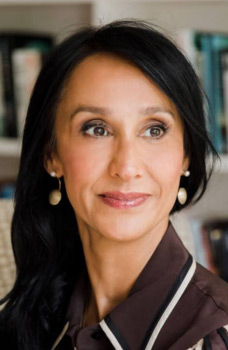
Chitra Divakaruni explains how her family, her childhood and the stories she was told have all influenced her writing.
When I was a child in India, my grandfather would tell me stories from the
Ramayan and Mahabharat, the ancient Indian epics. I loved to hear
about the wondrous exploits of divine warrior heroes such as Ram and Krishna,
and the magical weapons--the enormous bow, the fiery discus--with which they
destroyed evil kings and demons. There were human heroes too--the prince Arjun,
the greatest archer in the world and Krishna's best friend; Guha, the tribal
chieftain who loved Ram with all his heart. Their friendships--unselfish,
devoted, noble--were meant to inspire us to similar emotions.
Even more than the men, I loved the great women of the epics. There was Ram's
wife Sita, who gave up the pleasures of the palace to follow her exiled husband
to the forest. There was Draupadi, who exacted a terrible vengeance for the
humiliation she had to suffer at the hands of her husband's enemies. There was
Queen Kunti, who could call down gods to father her children. There was Shabari,
whose entire life was illuminated by her faith in Ram. Interestingly, unlike the
male heroes, the main relationships these women had were with the opposite
sex--with their husbands, sons, lovers, or opponents. They never had any
important women friends.
The aloneness of the epic heroines seemed strange to me even as a child. I could
see that this was not how women around me lived. In the traditional, largely
sex-segregated society of my grandfather's village, women spent most of their
day with each other, cooking together, working in the fields together, going in
a group to fetch water or to bathe in the women's lake. In the urban, more
modernized Calcutta where I lived with my parents, women met in the afternoons
to help each other pickle mangoes or stitch quilts or match-make for relatives or
they went to the afternoon shows of movies, where an entire section of the
cinema hall would be reserved for them. My mother, who was a teacher, took long,
gossipy lunches each day with the other women teachers in the Ladies Common
Room at school, and often in the evenings she went with the women of the
neighborhood to Geeta study class. These activities were important to her. And
though she loved her husband and children, I sometimes suspected she liked her
women friends more than she did us.
Perhaps, I thought, my grandfather had forgotten the stories about the women
friends. He was an old man, after all, though a wonderful old man. Perhaps
because he was a man he had not considered these stories important enough to
remember. When I was older, I vowed, I would search the epics for myself and
find them.
But when I did read the epics and other classic texts of Indian culture, I was
surprised to find few portrayals of friendships among women. In the rare cases
where such relationships appeared--the stories of Shakuntala or Radha, for
example--the heroine soon fell in love and left her friends behind to follow her
beloved. It was as though the tellers of these tales (who were, coincidentally,
male) felt that women's relationships with each other were only of significance
until they found a man to claim their attention and devotion.
Perhaps in rebellion against such thinking, I find myself focusing my writing on
friendships with women, and trying to balance them with the conflicting passions
and demands that come to us as daughters and wives, lovers and mothers.
Friendships are at the heart of stories such as "Affair," where the protagonist
suspects her best friend of having an affair, and is deeply hurt by the fact
that her friend has chosen not to confide in her, and "Meeting Mrinal," where
the main character meets her best friend and competitor from childhood after
many years and must decide whether or not to tell her about her broken marriage.
My latest novel, Sister of My Heart, explores the particular nature of
women's friendships, what makes them special and different. The two main
characters, Sudha and Anju, grow up in the same household, love each other
fiercely and completely, and know each other so well that they believe no one
else will ever know them this way.
I think I believe it too. In the best friendships I have had with women, there
is a closeness that is unique, a sympathy that comes from somewhere deep and
primal in our bodies and does not need explanation, perhaps because of the
life-changing experiences we share--menstruation, childbirth, menopause. The
same tragedies, physical or emotional, threaten us: the infidelity of a spouse
or boyfriend, rape, breast cancer, the death of a child who had grown inside our
body. Whether any of these strike us personally or not, if we hear of it
happening to a woman we love, we feel its reality like an electric shock along
our own spine. Even when we disagree with each other, we often know what the
other is going to say before she shapes the words. We take joy in the same
small, good things of life: the smell of fresh roasted cumin, a walk on a windy
beach, our favorite women writers and the women they write about, the way a new,
glittery lipstick brings out the shape of our mouth. Oh, we fight too. We're
sometimes furiously competitive and bitchy and exasperated. But ultimately we
can be ourselves with each other. Ourselves with all our imperfections.
Ourselves uncomplicated by all the emotions that complicate our other
relationships: duty, lust, romance, the need to impress or control. We can be
women and know that, as women, we are understood.
Copyright © 1998 Chitra Banerjee Divakaruni. Reproduced by permission of Random House publishing.
Unless otherwise stated, this interview was conducted at the time the book was first published, and is reproduced with permission of the publisher. This interview may not be reproduced or reprinted without permission in writing from the copyright holder.

Monica Ali is the daughter of English and Bangladeshi parents.
She came to England at the age of three, and her first home was Bolton in Greater Manchester. Ali later studied at Oxford University.
Her first novel, Brick ...
(more)
If you enjoyed:
Sister of My Heart
Try:
Brick Lane
by Monica Ali

Born in the eastern town of Rourkela, Badami spent her childhood drifting around India as her father, a mechanical engineer and train designer, was transferred frequently. Her family moved at least eight times before she ... (more)
If you enjoyed:
Sister of My Heart
Try:
Tamarind Woman
by Anita Rau Badami
We recommend 21 similar authors





He has only half learned the art of reading who has not added to it the more refined art of skipping and skimming
Click Here to find out who said this, as well as discovering other famous literary quotes!

Can you name the title?
Test your book knowledge with our daily trivia challenge!
Your guide toexceptional books
BookBrowse seeks out and recommends the best in contemporary fiction and nonfiction—books that not only engage and entertain but also deepen our understanding of ourselves and the world around us.
