
-
Your next favorite book
is waiting.

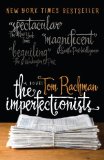
An interview with Tom Rachman about his first novel, The Imperfectionists, set in the offices of an English-language newspaper in Rome.
Karen Rigby interviews Tom Rachman
BB: How has studying cinema informed your writing?
TR: At college, I majored in film studies, so movies certainly affected how I tell stories. One strength of cinema is its speed: a movie must grip you and tell a story fast; it ought to pull you completely into the onscreen world. Movies have limits, though, struggling to move beyond what can be seen and what can be heard. The written story allows you to venture more deeply inside characters - a novel explores those aspects of people that, in day-to-day life, we cannot easily see or hear. This is what I hoped to do in The Imperfectionists, to bare the thoughts of a range of people who weren't necessarily shrieking but who were worth hearing. If my book also contains something of the pacing and directness of a good film, then I would be very happy.
BB: In many of the stories, relationships decline after pivotal events or quieter, emotional realizations. Rather than romanticizing the expat experience, they explore loneliness, infidelities, and death, among other struggles...
TR: Life overseas (the novel is set in Rome) can be thrilling and disheartening, liberating and constricting. You have the freedom to invent yourself, but lack the supports that your own culture offers. This makes expats a tight-knit bunch. However, the individual's experience can also be deeply isolating. That theme - being among people yet feeling alone - fascinates me; perhaps it is something I've felt. And it can occur anywhere, not only abroad. One might feel it at work, among acquaintances, even within a family.
BB: In an interview with The Australian you mention the cynicism that permeates the news world, and the imperfection of the enterprise and the characters that inhabit it. What was it like to balance the portrayal of this sometimes ruthless job and the desire to render the characters as endearing?
TR: Working in news is strange: journalists bump up against huge issues every day, yet remain rooted in smaller, personal issues, worrying about slights from colleagues, about promotions, about late buses, about what's for dinner. Their lives straddle the tremendously important and the tremendously trivial. It's inevitable; it's how humans respond. The consequence for journalists is often burnout or cynicism. When I imagined my characters, I didn't conceive of them as likeable or unlikeable, but tried only to understand them. Unexpectedly, this had the effect of making me sympathize even with those who, had I met them in real life, might have been tough to love.
BB: Lest the reader imagine it is a bleak book, resilience is also a strong quality that emerges. How did Arthur Gopal's arc come about?
TR: The book has a lot of humor in it, too, I hope. And while there is sadness and disappointment, that is only the flipside of aspiration and hope. Arthur Gopal is an obituary writer at the newspaper who feels uncomfortable writing articles about the dead or dying, and would much prefer to hang out with his eccentric 8-year-old daughter, Pickle. The last thing he's interested in is jockeying for position in the newsroom. Until, for reasons I won't give away, he changes his plans completely...
BB: Food plays a small but potent role: from the soup acquacotta di Talamone to Hardy's expert preparations…
TR: I was probably just hungry when I wrote those passages! No, I'm joking. Partly. I do love good food. I don't consider it a digression in life, but one of its great joys. Sometimes, I almost fear that the rest of my activities are just a sort of time-killing between searching for delicious meals! Over the past eight years, I have lived in Rome and Paris, and have been lucky enough to gobble a good deal of fine food and to learn about it, too. So, writing a book set largely in Italy, I couldn't help but integrate nibbles into the story itself.
BB: "Work-life balance" - an issue that is brought to the foreground in stories
such as Abbey's, whose son remarks that she is substituting work for love -
what makes it especially challenging in the news industry?
TR: Reporters are always on-duty. When they see their mobile phones lighting up with a call from headquarters, the adrenalin starts pumping: a fresh assignment. Yet others hear that phone ringing and their hearts drop, realizing that their attempts to pursue a life of their own are about to be curtailed again. Frequent travel, irregular hours, intense stress - this is not a combination that promotes an easy private life. I have seen the effects time and again, as journalists steam ahead with their careers while their personal lives are shunted and stunted. Is it the hard work that thwarts the private life? Or is it the thwarted private life that prompts the hard work? And this phenomenon exists far beyond the news industry - so many people toil admirably for their careers yet struggle when the workday ends...
To read an additional Q & A, please visit tomrachman.com
Unless otherwise stated, this interview was conducted at the time the book was first published, and is reproduced with permission of the publisher. This interview may not be reproduced or reprinted without permission in writing from the copyright holder.

Julia Dahl is a journalist specializing in crime and criminal justice. Her first novel, Invisible City, was named one of the Boston Globe's Best Books of 2014, won the Macavity, Barry, and Shamus Awards, and was a finalist ... (more)
If you enjoyed:
The Imperfectionists
Try:
Invisible City
by Julia Dahl
Joshua Ferris is the author of three previous novels, Then We Came to the End, The Unnamed and To Rise Again at a Decent Hour, and a collection of stories, The Dinner Party. He was a finalist for the National Book Award, ... (more)
If you enjoyed:
The Imperfectionists
Try:
Then We Came to the End
by Joshua Ferris
We recommend 8 similar authors



The most successful people are those who are good at plan B
Click Here to find out who said this, as well as discovering other famous literary quotes!

Can you name the title?
Test your book knowledge with our daily trivia challenge!
Your guide toexceptional books
BookBrowse seeks out and recommends the best in contemporary fiction and nonfiction—books that not only engage and entertain but also deepen our understanding of ourselves and the world around us.
