
-
Your next favorite book
is waiting.
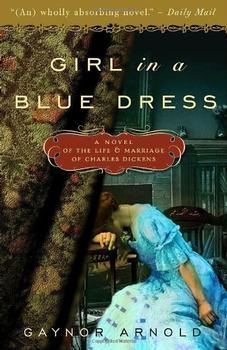
A conversation with Gaynor Arnold about her first novel, Girl in a Blue Dress, inspired by the life of Charles Dickens's second wife, Catherine Dickens.
What inspired you to write Girl in a Blue Dress?
It's a long story, starting in my childhood when I
first became fascinated by the novels of Charles Dickens. Later, I graduated to
reading about his life and became equally fascinated by his rags-to-riches
story, his thwarted loves, his doomed marriage, and his secret mistress. The
more I read, the more intriguing it seemed that a man so full of compassion for
his fellow men—and who was such a supporter of family life and the sanctity of
the home—came to act so harshly towards his wife. I was fascinated by the
contradictory psychology of the man, and the psychology of the whole marriage (a
supremely Victorian marriage), but it did not occur to me for many years that
there was a novel in it. After all, the facts were a matter of public record,
painstakingly researched by professional biographers; what could I add? I was in
the meantime busily writing about contemporary men and women. However, the
"Charles Dickens story" niggled away at me and gradually the notion evolved that
maybe I could write something from the point of view of the scorned wife, a
woman about whose thoughts and feelings relatively little is known. This notion
was strengthened when I learned how Catherine Dickens had pathetically handed
over her love letters for public scrutiny in the hope "that the world may know
that he loved me once." It suddenly opened up the possibility of a fictional
piece of writing, and once I had my Dorothea's authentic "voice," I was away…
How much of the novel is historically accurate?
It's a mix. The gist of it is true, but I have rejigged many events and changed many of the dramatis personae, while
making others up completely. I deliberately gave my protagonists different
names—Dorothea and Alfred Gibson—so that they could be free to do and say what I
wanted them to without bringing up charges of inaccuracy from Dickens scholars.
Nevertheless, I have kept within the parameters of fact for
the main narrative: i.e., a young man of humble origins, with a scar on his soul
from his childhood experiences, enjoys a stratospheric rise to fame shortly
after his marriage to a mild and agreeable young woman whose comfortable
background is so at variance with his own. He goes on to be the most famous
writer of his day—a workaholic, possibly a manic-depressive, churning out weekly
journalism, serial novels, thousands of letters, performing in plays, devoting
himself to charitable ventures, and finally killing himself with the strain
involved in public readings of his work. Alfred Gibson, like Charles Dickens,
falls in love all the time, most notably with his sister-in-law and, in his
final years, with an actress young enough to be his daughter. He puts his wife
out of her home in the most humiliating of circumstances and refuses to see he
is any way in the wrong.
However, Dorothea's story—the story of Girl in a Blue
Dress, although containing much of the placidity, depression, and occasional
bouts of jealousy that are characteristic of Catherine Dickens—has many more
invented scenes (including her unhistorical meetings with Queen Victoria and
Miss Ricketts). Nearly all the domestic events and her relationship with
O'Rourke and her children are very highly fictionalized, and, of course, the
conclusions she draws are very much her own.
In some places I have played with characters from Dickens's
own books and deliberately included echoes of some of his phrases. I have also
added events to create a parallel effect on the modern reader; for example,
Charles Dickens did not have a public funeral, but by giving Alfred one, I hope
to convey to the reader how enormously famous (and almost worshipped) he was
when he died; the scenes of public grief reflecting, perhaps, Princess Diana's
modern-day obsequies.
Are you a fan of Charles Dickens? Did your research change
your vision of him?
I am a terrific fan of his writing, and I admire much
about the man himself—his tremendous energy, his vivacity, his capacity for
work, the way he threw himself into projects to help the poor and less
fortunate, his tenderness with children, his capacity for friendship, his
fantastic sense of humour. But I have always known that there was a darker side
to him—his obsessiveness, his self-centerdness, his control-freakery, his
capacity for self-deception, his conviction that he was always right, his almost
casual cruelty when his own interests were at stake. I was aware of these two
sides to him before I set out to write the book. What I wanted to do was to
explore these contradictions myself to make sense of them in an imaginative way
and see the man through the eyes of a woman who never ceased to adore him.
People often ask me whether I would have liked to have met him. My first thought
is, of course I would, he was so clearly charismatic. But at the same time, I
draw back slightly. There's a lot about his attitudes to women that I dislike
(patronizing, paternalistic, sentimentalizing), and I wonder how he would take
to the assertiveness of a modern woman. Yet all the same, I would hate to pass
up the chance to witness at first hand his wonderful humour, high spirits, and
warmth. Life around him was clearly never dull, and he seems to have been great
company provided he was in the right mood (and perhaps in small doses).
What were your research processes like?
I have to confess that I did very little traditional
research for this book, knowing a fair amount about my subject already. I read a
brief social history of the nineteenth century in England just to remind myself
of certain facts, and after that, I just winged it and hoped everything would
sound all right. I think the value of money was my greatest bugbear, and then
things like modes of transport (barouche or brougham? fly or gig? Hansom cab or
Hackney carriage?). Items of clothing probably came next (When did crinolines
come in and go out? Is it all right for Dodo to wear a pelisse in 1870?). Then I
had to check things like the geography of London as it was at various points in
the nineteenth century—which bridges existed, when the embankment was built,
where the railway lines went. It was all quite small stuff which didn't take all
that long to look up, and I did it very much as I went along. I used books I
already had around the house or (occasionally) the internet. Mayhew's London
Life was good to give a flavor of the streets, but in the end I found going
back to the novels of Dickens was the greatest help. He is the best chronicler
of the nineteenth century, and full of all sorts of detail you can't get
elsewhere.
Unless otherwise stated, this interview was conducted at the time the book was first published, and is reproduced with permission of the publisher. This interview may not be reproduced or reprinted without permission in writing from the copyright holder.

Tracy Chevalier was born in Washington, DC but has lived in England all her adult life. She now has dual citizenship. She has a BA in English from Oberlin College, Ohio and an MA in creative writing from the University of ... (more)
If you enjoyed:
Girl in a Blue Dress
Try:
Remarkable Creatures
by Tracy Chevalier

Daisy Goodwin is the author of the New York Times bestselling novels The Fortune Hunter The American Heiress. She is a Harkness scholar who attended Columbia University's film school after earning a degree in history at... (more)
If you enjoyed:
Girl in a Blue Dress
Try:
The American Heiress
by Daisy Goodwin
We recommend 5 similar authors




Polite conversation is rarely either.
Click Here to find out who said this, as well as discovering other famous literary quotes!

Can you name the title?
Test your book knowledge with our daily trivia challenge!
Your guide toexceptional books
BookBrowse seeks out and recommends the best in contemporary fiction and nonfiction—books that not only engage and entertain but also deepen our understanding of ourselves and the world around us.
