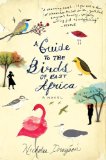
Nicholas Drayson discusses his second novel, A Guide to the Birds of East Africa.
Would you describe yourself as a birder?
I'd describe myself as more of a naturalist—I like nature as a
whole and in all its parts. I get just as much pleasure in watching a wasp
hunting for spiders, a family of baboons, or the colors of the New England fall
as I do in seeing a bird that I have never encountered before. The great thing
about birds, though, is that they are easy to see and study. There are lots of
them, they can be found nearly everywhere, most of them fly around happily in
the daylight, and they make such great noises.
What made you decide to write this book?
Ten years ago I finished my Ph.D. and married the world's most
beautiful Antarctic lexicographer, Bernadette Hince. Bernadette had just
accepted a job as publications editor in an international agroforestry research
center in Kenya, and we moved from Australia to Nairobi. I had done a lot of
nature writing in Australia but, having no job and no work permit in Kenya, I
decided to bite the literary bullet and write a novel. This situation also
allowed me to spend a lot of time looking at Kenya's spectacular
wildlife—including its birds. When we left Kenya a year and a half later, I took
with me a manuscript (Confessing a Murder, Norton, 2002) and experiences
that I knew would one day turn into another book.
Your book is set in Africa, but its main character is Asian. How
come?
An enormous diaspora of people has flowed from the Indian
subcontinent to Africa, as well as to other parts of the world, over the past
hundred years. Many of the "Asians" in Kenya arrived early in the past century
to help build the railway and thus have been established there quite as long as
the white population. Kenya is a country of many tribes, and you could argue
that the Asians and the whites now fit in as two of them. When I decided to
write a book set in Kenya, I wanted to acknowledge this.
How long did it take to complete?
I started A Guide to the Birds of East Africa about five
years ago but, typical of what happens when I write, another project somehow
overtook it (Love and the Platypus, Scribe, 2007). I got back to it in
2006 while staying in Cambridge, England, where Bernadette had a research
fellowship at the Scott Polar Research Institute. I finished it last year. It
seems to take me about a year and half to write a novel—which sometimes seems
crazy because you can read it in a few hours.
Do you enjoy writing?
When I started writing my first novel, it was so much fun. I was
used to writing nature stories for magazines and had just finished a major
academic dissertation—all of which involve considerable research and attention
to detail. When I realized that with a novel I could just make everything up, it
felt great. Freedom! But it's hard work too. Like many writers, what I really
enjoy is not so much the writing, but having written.
A Guide to the Birds of East Africa— it doesn't really sound
like a novel at all. Why did you choose that title?
Unusual for me, the title came first—it popped into my head
while I was still living in Africa. We'd made friends with the Dutch artist Ber
van Perlo, who was working on illustrations for an African bird guide (Birds
of East Africa, Collins), and something about the rhythm of the phrase stuck
in my head. Rhythm is very important to me, both in music and words.
Do you have a favorite bird?
That depends on where I am. At home in Canberra it would have to
be the Australian magpie—for its matchless song. I can look out my window and
see perhaps a dozen different kinds of parrot; yesterday twenty yellow-tailed
black cockatoos flew over, making their deliciously mournful cries. On the other
hand, when I'm staying with my sister in England, I love to hear the sound of
rooks and jackdaws coming home to roost in the evening, in the sycamores beside
the old church. In the United States, I just can't get enough of the
hummingbirds. As for Africa, well, perhaps you can guess from the book.
You live in Australia, but you grew up in England?
Yes, I've lived nearly half my life in Australia now. I consider
myself very lucky to feel at home in two such different places. The England I
know is so much more than London, and the Australia I know is so much more than
beautiful beaches and magnificent deserts. And it's not just the land, it's the
people. Plus, of course, Australia is heaven for a naturalist—and it's just so
different from the Northern Hemisphere.
What would you say is the central theme of A Guide to the
Birds of East Africa?
When I look back, the themes of all my novels seem to be the
same—basically they are love stories. But I like to try different styles and
voices, so this one is much funnier than my previous novels. And it's always
important to me to work hard on the plot. I do so enjoy a good story.
When readers finish A Guide to the Birds of East Africa,
what do you hope they will be feeling?
Happy. Not because they enjoyed the book or because they think
it a great work of literature or even a good story (though all these things
would be nice), but just happy with life. Bad things happen in this book, but in
many ways the book is about the goodness of people and the triumph of that
goodness.
Any plans for your next novel?
I'm working on a couple of books at the moment—a crime story set
in Sri Lanka and a sequel to A Guide to the Birds of East Africa. I
wouldn't like to go on the record and say which one will be finished first.
Unless otherwise stated, this interview was conducted at the time the book was first published, and is reproduced with permission of the publisher. This interview may not be reproduced or reprinted without permission in writing from the copyright holder.

Alice Greenway divides her time between the United States and Britain. Her first novel, White Ghost Girls, set in Hong Kong in the 1960s, won the Los Angeles Times Award for First Fiction and was on the Orange Prize longlist.... (more)
If you enjoyed:
A Guide to the Birds of East Africa
Try:
The Bird Skinner
by Alice Greenway

Wangari Muta Maathai was born in Nyeri, Kenya (Africa) in 1940. The first woman in East and Central Africa to earn a doctorate degree. Wangari Maathai obtained a degree in Biological Sciences from Mount St. ... (more)
If you enjoyed:
A Guide to the Birds of East Africa
Try:
Unbowed
by Wangari Maathai
We recommend 6 similar authors





The House on Biscayne Bay
by Chanel Cleeton
As death stalks a gothic mansion in Miami, the lives of two women intertwine as the past and present collide.

The Flower Sisters
by Michelle Collins Anderson
From the new Fannie Flagg of the Ozarks, a richly-woven story of family, forgiveness, and reinvention.

The Funeral Cryer by Wenyan Lu
Debut novelist Wenyan Lu brings us this witty yet profound story about one woman's midlife reawakening in contemporary rural China.
Your guide toexceptional books
BookBrowse seeks out and recommends the best in contemporary fiction and nonfiction—books that not only engage and entertain but also deepen our understanding of ourselves and the world around us.