
-
Your next favorite book
is waiting.
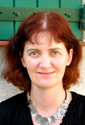
How to pronounce Emma Donoghue: don-a-hue
An Interview with Emma Donoghue about her 2010 award-winner, Room.
Jack is such a unique narrator. At what point did you decide to tell the story from his perspective?
I never considered any other perspective: letting Jack tell this story was
my idea in a nutshell. I hoped having a small child narrator would make
such a horrifying premise original, involving, but also more bearable:
his innocence would at least partly shield readers on their descent into
the abyss. I also knew that Jack would have some interesting things to
say about our world, as a newcomer to it; the book's satire of modern
mores and media, and interrogations of the nature of reality, grew out
of Jack's perspective rather than being part of my initial plan. I did have
some technical worries about having such a young narrator: I knew the
prospect of being stuck in a little kid's head might turn some readers off.
But I never feared that Jack would be unable to tell the whole story.
How did you manage to get so thoroughly into the mind-set of a
five-year-old boy?
It was a help that my own son was five, but it's not like Finn and Jack
have much in common: Finn has been as shaped by sociability and
freedom as Jack has by routine and one-to-one time with his mother.
I tried to isolate elements of my son's behavior and mind-set and
speech that any five-year-old would share, but then I thought of all
the ways in which Jack's limited experience has shaped him. So I sat
there doing a constant nature-versus-nurture debate in my head.
Jack knows a lot of things, but in other ways he hasn't a clue.
Which books were influences on Room? This book seems so different
from your other novels. Some people have even classified Room
as a thriller — would you agree?
My main concern was to avoid the "true crime" genre. From the start
I saw this novel as having elements of fairy tale, horror, science fiction,
and those wonderful eighteenth-century novels with wide-eyed
traveler narrators (Gulliver's Travels, Robinson Crusoe, Candide). I
designed Room to work on several levels. First and foremost to be a
clean book: straightforward, clearly and linearly narrated, realistic.
But also with lots of extras smuggled in for readers (like my professor
partner) who relish that kind of thing: echoes of texts from Plato, to
the King James Version of the Bible, to Portrait of the Artist as a
Young Man, to The Catcher in the Rye. Although I never thought of
Room as a thriller, exactly, I'm rather thrilled whenever somebody
fi nds it page-turning enough to call it that! Another genre I kept in
mind was children's / young adult: although Room was not published
specifi cally for young readers, I always thought they might find it.
The character of Ma is just as compelling as that of Jack, and the
bond between them is intense.
How did you conceive of their relationship
as you were writing?
Let me start by saying that Room is not one of those horror stories
in which family members confined together (remember Flowers in
the Attic or The Blue Lagoon) turn to incest. Ma and Jack have a
strangely intense relationship, but I always meant it to be a healthy
one. It's got lingering elements of the mother-baby bond (for instance,
in the breastfeeding) as well as aspects of alliance and friendship. I
tried to slide it along that developmental range, so there are times
when he's her buddy or her peer and times when he's a toddler boy.
For me Room is a universal story of parenthood and childhood,
and in Jack and Ma's relationship I wanted to dramatize the full
range of extraordinary emotions parents and children feel for each
other: to put mothering in a weird spotlight and test it to its limits.
Because it does have limits. Yes, Room celebrates mother-love,
but it also painfully calculates those moments when Ma has to recognize
that Jack needs something other than her protection. Those
moments all parents come to when love takes the form of stepping
back, letting go.
Do you think of Jack and Ma as being fundamentally different from
people "Outside"?
In the second half of the book, Ma and Jack are made to feel like
freaks, but I always wanted to treasure them on their own terms. I
sometimes thought of them tribally: a lost tribe of two. They've got
things in their heads like Kylie Minogue songs, which Ma has
brought from the old civilization, but what they've come up with is a
strange kind of island culture, island religion, and a peculiar (occasionally
pidgin) form of English. I found that if I used these anthropological
concepts, it stopped me from seeing Jack and Ma as being
stunted versions of modern Americans.
Jack and Ma frequently give thanks to Baby Jesus. Did you originally
think that faith would be important to them in their situation?
I've always been religiously inclined, but it doesn't come up in most
of my books.
I knew it would be central to Room because prisoners
cling to whatever tatters of faith they've got. Look at those Chilean
miners and their daily prayer groups.
Actually, I'm not sure how literally Ma believes in all that, but it
certainly makes sense that she would have taken whatever vague
Christian framework she had and offered it to Jack as part of her
system for making meaning of their days, and keeping hope alive.
Kids delight in "magical thinking," whether in the form of the Tooth
Fairy or the saints. Whether you see these as comforting lies or eternal
verities, they are part of how we help kids make sense of the
world. I think that's why the religious element of Room doesn't seem
to bother nonreligious readers; they can just put it on a par with
Santa. But for me, Room is a peculiar (and no doubt heretical) battle
between Mary and the Devil for young Jesus. If God sounds absent
from that triangle, that's because I think that for a small child, God's
love is represented, and proved, by mother-love.
The second half of the book feels very different from the first, for
obvious reasons. Did you conceive of this structure early on, or did
it come later?
I always saw the novel as having two halves, each of which would
shed a different light on the other. As always happens with a book in
two halves, reviewers tend to prefer one over another: many find the
second half more ordinary, but a few find it a relief after the claustrophobia
of the first.
In the first half, Ma has some superhero traits, and even Jack has
some larger-than-life qualities. Their strengths are in proportion to
the dangers, like in fairy tales. In the second half, I really wanted to
let them relax into being human. That's been a controversial element:
some readers want Ma to remain Super Ma. Her relationship
with Jack is shown as being flawed, too, and some people find that
hard, but for me it made the book much more honest. If Room had
only covered the first half, it would have been far too feel-good, both
in its depiction of mother-love and its implication that Outside, the
wider society, represents a simple happy ending.
You have mentioned that you drew inspiration from real-life imprisonment
cases, such as that of the Fritzl family. Did you worry that
in doing so critics might accuse you of sensationalism?
No, because I was naive. I never expected that being upfront about
the particular headline that happened to trigger the idea for Room
would have such consequences. I realize now that if your book gets
attached to any notorious names, you can never shake them off. Lazy
journalists call Room "a book about Josef Fritzl" — which I would
have thought anyone skimming the first few pages would realize it
isn't. Others, not even bothering to Google it, assert that it's about
Jaycee Lee Dugard — who hadn't even been discovered by the time I
wrote the novel. The truth is that it's about none of these real people. All I borrowed from the Fritzl case was the notion of a woman who
bears a child to her captor and manages to protect his childhood.
The irony is that I have often written fiction closely based on real
people and events, but if it's before 1900, nobody minds.
What sort of research did you do for Room?
I did too much. I don't mean in quantity: like any writer of historical
fiction, I go by the principle of digging up a hundred times more than
I will actually use on the page. I mean in terms of what I could bear.
I pushed myself, for instance, to find out how badly and weirdly children
can be raised by adults who hate them, what they can survive
and what they can't: I read every case on www.feralchildren.com.
But that kind of grim research did end up yielding some very positive
elements in Room. I thought, above all, that what Ma has given to
Jack is language: that's why there's nothing "feral" about him.
I researched births in concentration camps, children conceived
through rape, children living in prison. I read up on terrible things that
happen to adults too (above all, the mind-breaking solitary confinement
of approximately 25,000 American prisoners at any one time). But it's
the kids who trouble me most. I always knew that Jack's story would be
made bearable by Ma's constant love, but some of the children I read
about when planning Room ... let's just say I can't get them out of my
head. I was left with a fierce sense that nothing I do is more important
than giving my son and daughter what they — what all kids — deserve.
What are you working on now?
I'm working on a novel set in San Francisco in the 1870s. It's another real
case (like Slammerkin, Life Mask, and The Sealed Letter), a murder
that's never been solved. My characters are mostly French immigrant
lowlifes. I've never done a historical novel set in North America before;
I'm enjoying the crazy modernity of nineteenth-century San Francisco.
My other main interest is in Room making it to the big screen in
a way that would capture its magic without veering off in the direction
of either schlock or sentimentality. Watch this space.
Unless otherwise stated, this interview was conducted at the time the book was first published, and is reproduced with permission of the publisher. This interview may not be reproduced or reprinted without permission in writing from the copyright holder.



David Almond, in his own words:
I was born in Newcastle and I grew up in a big Catholic family in
Felling-on-Tyne. I had four sisters and a brother and lots of relatives in the
streets nearby. My dad had been in Burma ...
(more)
If you enjoyed:
Room
Try:
The True Tale of the Monster Billy Dean
by David Almond
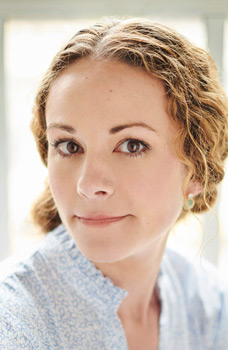
Clare Beams is the author of the story collection We Show What We Have Learned, which won the Bard Prize and was a Kirkus Best Debut of 2016, as well as a finalist for the PEN/Robert W. Bingham Prize, the New York Public ... (more)
If you enjoyed:
The Wonder
Try:
The Illness Lesson
by Clare Beams
We recommend 51 similar authors







Life is the garment we continually alter, but which never seems to fit.
Click Here to find out who said this, as well as discovering other famous literary quotes!

Can you name the title?
Test your book knowledge with our daily trivia challenge!
Your guide toexceptional books
BookBrowse seeks out and recommends the best in contemporary fiction and nonfiction—books that not only engage and entertain but also deepen our understanding of ourselves and the world around us.
