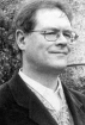
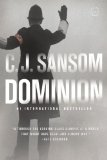
A conversation with C.J. Sansom, author of Dominion, about the definition of historical fiction and his fascination with history.
Could you tell us about your inspiration for writing Dominion?
Everyone who studies history seriously considers counterfactuals — if a particular event, or decision, had gone differently, what would the effects on history have been? And of course one intriguing theme is what would have happened if Britain had been defeated or surrendered in 1940.
What drew you to the particular era that your book depicts? What are some of the challenges and/or delights about writing about this time?
As well as the Tudor era, I have always been very interested in European and British history before, during, and after the Second World War, and Winter in Madrid is also set within this broad period. Dominion's setting is Britain in 1952 , the year I was born. Although it is an alternate history and many things are different, I try to catch the atmosphere of 1950 s Britain in such things as the general drabness, the intense social
conservatism, but also the importance of personal integrity as epitomized in characters like David and Sarah. It was very interesting to create characters rooted in a time which I can just remember, as well as little details like the fact that everybody smoked, and it was routine for dogs to do their business in the street! One of the challenges, which I would have had even writing about the real world rather than an alternate history, is that events and political figures are still, just, within range of memory, as are the political ideas. I knew I would get criticism for my portrayal of how some political figures and political parties respond to defeat, but I believe these to be plausible, or would not have proceeded as I have.
You are very well known for your Shardlake mysteries set in Tudor England, as well as Winter in Madrid. What premises did you use to transport yourself (and readers) to another time period? How do you go about research and incorporating it into fiction?
That is the $ 64,000 question for a historical novelist. I am fortunate in that I am a history nerd, and have spent much of the last forty years reading and thinking about history. I don't have the knowledge of a professional academic, but think I am fairly well rooted in the mid-sixteenth and mid-twentieth centuries.
Whenever I have chosen the exact topic I'm going to write about, I always research the particular subject as carefully as I can, including looking at original documentation from the
period wherever possible. This takes two to three months and I'm sure that much of each novel is written in my subconscious during that time. Then when I write, I always try to strike that essential balance between burdening the reader with a mass of historical facts and giving the flavor of the time. That's the key thing: having the character and stories integrated with "the world of the piece."
Do you believe your historical fiction conveys a message or theme relevant to our world today? If so, what do you think it is? If not, how do you think readers can find common ground with the characters in your story?
Everyone, I think, who writes historical novels — or, for that matter, factual books, does so from the perspective of their own time. I don't think there is such a thing as a general "message" or "theme" in historical fiction — everyone writes from the point of view of their own ideas, conscious or unconscious. I am sure my own books reflect my own position on the democratic Left. The only book where I have deliberately conveyed a message is Dominion, where the message is how easy, and how dangerous, it is to fall into politics defined by nationalism.
As for common ground with the characters, a difficult balance has to be drawn between someone intelligible to the modern world but with the different mindset of another time. This is much easier for the 1940s than the 1540s!
Can you tell us about your next project?
I am going back to Tudor England and the Shardlake series, with a book called Lamentation, which will be set around the jockeying for power between religious and political factions at the court of the dying Henry VIII, and which will prominently feature his last wife, Catherine Parr. It will be the last in the series set during the reign of Henry VIII, but I hope to continue it under his successors.
This interview originally appeared on HistoricalBoys.Blogspot.com in March 2014 and is reprinted here with the permission of the interviewer, fellow historical novelist C. W. Gortner. He welcomes visitors at CWGortner.com.
A Conversation with C.J. Sansom, author of Winter in Madrid
What inspired you to write a book about Spain and
specifically about the period of time after the Spanish Civil War?
I first studied the Spanish Civil War as my undergraduate special subject at
University, so gained a very good introduction to sources in English on the
period. My course stopped in 1939 with Franco's victory but I was interested in
reading on and seeing what happened to Spain during the Second World War, and
decided I would like to write a spy novel set in that period. I worked as a
lawyer for many years and by the time I gave that up in 2000 and had the time to
write, books about the Civil War and the 1940s were starting to appear in Spain.
My reading Spanish was not really good enough to use untranslated books as
source material, but there were several books by English historians, and also I
had managed to track down a number of books and memoirs written by journalists
and British diplomats who were in Spain at the period. Meanwhile I had been
visiting Spain and especially Madrid for a number of years, and managed to get
items like a map of contemporary Madrid, coins and stamps -- and also a
three-volume book of photographs of 20th-century Madrid. I also visited all the
locations mentioned in the novel. The British Embassy is still in the same
street, but the old building has gone to be replaced with a hideous modern
building, so I had to imagine the old one.
Both Spain and the country's modern history fascinated me
from the time I first began to learn about them in the 1970s. I felt that quite
a lot had been written about the Civil War, with an emphasis on Barcelona, and I
wanted to write about what life in Madrid was like after its conquest by Franco,
Madrid being my favorite Spanish city. There are many British novels about the
Second World War and I wanted to write about Spain as a wartime setting that
no-one had really done before -- a forgotten corner of the Second World War.
Other than your studies of Spanish History, can you
find any other inspiration for Winter in Madrid from your life?
Things in my personal life that helped inspire the
book, perhaps that I was brought up on public-school novels [note: British
public-school is similar to US private or preparatory school] and became
interested in that whole into war public school ethos and the oddballs it often
produced -- rebels like Sandy and Bernie and conformists like Harry who
sometimes found themselves questioning things in the very different world of the
war. Also, brought up in the 1960s and the early days of women's liberation, I
was interested in how women can change and become more assertive. With the
character of Barbara I wanted to portray a woman who in her very different time,
grows from "a mouse to a lion." Barbara is actually the main character of the
book -- the one who develops most and who provides the narrative glue that holds
everyone else's story together.
How accurate would you say the history and politics of
your novel are? Do you feel some sense of responsibility to be factually
accurate when one writes historical fiction?
I think it is important for a historical novelist
never to consciously mislead the audience. So everything about what was going on
politically at the period is accurate, and I have made the setting as authentic
as I can. On one or two occasions where I have made small
alterations to historical fact, I have said so in the Historical Note. The
characters, apart from brief appearances by real people as mentioned in the
Historical Note, are all fictitious. Of course I have a personal slant on what
is going on -- every historian does, and a historical novelist more so. It will
not take the reader long to realize that I do not like Franco or his regime.
Do you think your Spanish readers will find Winter in Madrid authentic?
Whether it will be convincing to people who still
remember those years I do not know -- I very much hope it feels authentic to
them, and in a way the book is written for them because the terribly hard lives
they led in the 1940s have in many ways been forgotten. But I must wait and see
what people think. I am very much aware that pretty much every Spanish family
has a parent or grandparent who suffered during the Civil War at the hands of
one side or the other, and during the years of hunger that followed.
Can you expand on how the Spanish Civil War and the
Franco years affected Spain versus the rest of Europe?
I think in many
ways the Spanish Civil War and the Franco years had opposite effects in Spain
and in the rest of Europe. In Europe the war has in many ways been viewed as the
ultimate story of political struggles between fascism, democracy and communism,
often perhaps idealized. In Spain nothing approaching impartial analysis could
be written about the Civil War under the Franco regime, and then there were the
long years of the pacto de olvido -- the pact of forgetting, when people
deliberately did not mention the Civil War, perhaps because of the passion that
it still evoked. That left Europeans and perhaps particularly English historians
to write about this fascinating and terrible period. However in the last decade
Spaniards have begun studying the Civil War and the 1940s with new interest.
Why do you think the Spanish Civil War and its
aftermath haven’t been as freely discussed in Spain?
I'm hesitant to
comment too freely on this matter, because I am not a Spaniard. But I think the
sheer weight of suffering of the Civil War, together with the legacy of fear
left by the Franco regime, has meant that Spaniards have understandably
preferred to avoid discussing the past, until recently. But perhaps it is now
time.
History is a subject where it is very easy to remember what
suits us in an ignorant and distorted way; especially where conflicts between
nations and ideologies are concerned. I hope reasoned study of the past can lead
to a better understanding of it and, if not to impartiality, which is not
necessarily a good thing, to realize that it isn't all angels on one side and
devils on the other, and that a lot of innocent people get caught in the middle
of historical conflicts.
Why are you drawn to write about the past?
I find myself drawn to write about the past because
ever since my student days I have thought imaginatively about what it must have
been like for people to live in the past, and have found myself particularly
drawn to the moral dilemmas the literate classes often find themselves in at
times of ideological conflict -- whether Reformation England or the Second World
War. In US history I guess the time that choices were starkest was during the
American Civil War. Also, knowing that I am middle-aged in some ways I find the
past more accessible than our present world of computer technology, celebrity
culture, casual violence and globalization. Perhaps that is why the only
non-historical piece I have written is a novella set a hundred years in the
future.
Unless otherwise stated, this interview was conducted at the time the book was first published, and is reproduced with permission of the publisher. This interview may not be reproduced or reprinted without permission in writing from the copyright holder.

Vanora Bennett became a journalist almost by accident. Having learned Russian and been hired after university by Reuters, she was catapulted out of the classical-music life of her family and straight into the adrenaline-... (more)
If you enjoyed:
Revelation
Try:
Portrait of an Unknown Woman
by Vanora Bennett

Charles Cumming is a British writer of spy fiction. He was educated at Eton College (1985-1989) and the University of Edinburgh (1990-1994), where he graduated with First Class Honours in English Literature. The Observer has ... (more)
If you enjoyed:
Winter In Madrid
Try:
The Spanish Game
by Charles Cumming
We recommend 19 similar authors
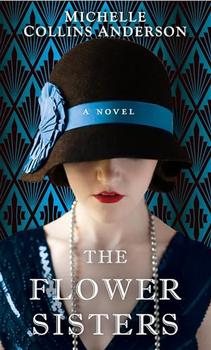
The Flower Sisters
by Michelle Collins Anderson
From the new Fannie Flagg of the Ozarks, a richly-woven story of family, forgiveness, and reinvention.
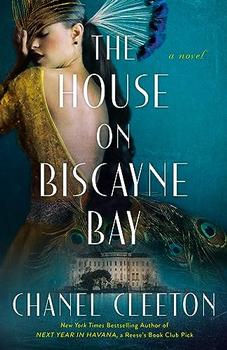
The House on Biscayne Bay
by Chanel Cleeton
As death stalks a gothic mansion in Miami, the lives of two women intertwine as the past and present collide.
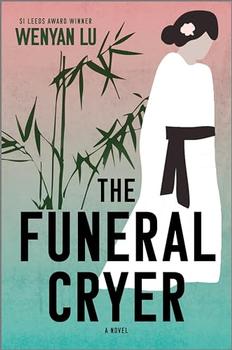
The Funeral Cryer by Wenyan Lu
Debut novelist Wenyan Lu brings us this witty yet profound story about one woman's midlife reawakening in contemporary rural China.
Your guide toexceptional books
BookBrowse seeks out and recommends the best in contemporary fiction and nonfiction—books that not only engage and entertain but also deepen our understanding of ourselves and the world around us.