In two separate interviews, Anchee Min discusses Empress Orchid, the first of two planned novels about the last Empress of China, a country girl who seized power through seduction, murder, and endless intrigue; and her more recent novel, Pearl of China, about the life of Pearl Buck.
Pearl of China is the story of Pearl S. Buck. Why did you decide to
tell Pearl's story?
Pearl Buck and I have a long history together, and in some sense
that story is at the heart of my novel. As a teen back in China in
1972 during the Cultural Revolution, I was asked to denounce Pearl
Buck as an "American cultural imperialist." Though I wasn't given a
chance to read The Good Earth, I dutifully went ahead and made the
denunciation. Years later, when I was living in America and on a book
tour for my memoir Red Azalea, a fan thrust a copy of Buck's most
famous novel into my hands as a gift. I read the book on a plane and
burst into tears. I cried because I realized how beautifully Buck had told
the story of the Chinese peasant, in a way that few others, even Chinese,
had ever done. And I cried because I was only then realizing this, and
that I was only one of a generation that had been indoctrinated to think
poorly of Buck.
I wrote the novel to show where Pearl's great sensitivity and insight
into the Chinese and Chinese culture came from. And also to show how
the relationship between Pearl Buck and China changed over time, just
as mine had changed. Right now, Pearl Buck is finally being celebrated
in China, for the first time. That is a good sign for international
relations between the U.S. and China.
How did you conduct your research on Pearl's personal life?
First, I continued reading Pearl's own writing and continued to be
amazed at her perspective, how well she knew the Chinese. Pearl not
only grew up in China, but grew up with the people, who she loved and
didn't feel separate from. One of the most important things I did was
to spend time in the town where Pearl Buck grew up. It was the town
Pearl called "Chin-kiang," which we call "Zheng Jiang" today.
I wanted to know who her childhood friends and neighbors were and
how those folks thought of her. Some she stayed in contact with for over
forty years - some of the same people that refused to denounce Pearl
during the Cultural Revolution. But people were afraid to talk to me
at first. The memories of the brutal persecution during the Cultural
Revolution were still fresh. I kept returning until one day I was referred
to a dying pastor. The local man who introduced me said that "the pastor
is ready to open up because he was told by the doctor that he has only
few days left to live," which meant that he, the pastor, could afford to tell
the truth and escape punishment. I felt terrible to steal the dying man's
last moments, but the pastor insisted that he see me.
When I went looking for confirmation about who had denied Pearl
Buck a visa to China in 1972, I also got lucky. I suspected Madame Mao
was behind the rejection but had no proof. So I was thrilled when I met
Pearl Buck's daughter Janice at the Pearl Buck House in Pennsylvania
in 2007. Janice told me that her mother believed that it was Madame
Mao, and she listed the reasons, all of which made sense to me. Janice
also shared with me some wonderful details about her mother, for
example, about the Chinese pond Pearl created in her backyard and
Pearl's passion for Chinese camellias.
The Christian community that Pearl's father belongs to is an
important part of the novel. The Christian presence in China was always
controversial and was the center of the Boxer Rebellion. How did you
feel about it as you wrote the novel?
The Christian community in China has had a long history, some
chapters have been very positive, some not so. Christian ideas were
foreign ideas, and China has been a very tradition-bound culture. Some
of what you feel about the Christian influence in China is how you
feel about traditional Chinese culture. The period I wrote about, from
just before the Boxer Rebellion through the Cultural Revolution, was a
period of great chaos and violence in Chinese history. Some might say
that Christian influence played a part in bringing this on - I don't think
so. It was just China coming into the modern age, violently. What I do
know is that I came to see the large and growing Baptist community
of which Pearl's father was at the center as something that provided a
caring, human, and relatively sane refuge in the midst of the craziness
of the Cultural Revolution. True believers were not as susceptible to the
kind of brainwashing that occurred on a massive scale then.
Another reason I had positive feelings toward the community was my
mother's own faith. I regret that I had never bothered to learn about my
mother's Christian background until it was too late. I wish that I had
asked my mother some questions, which bothers me now. For example,
who converted her as a child? And how was her value system, by which
I was raised, built? I only witnessed how my mother struggled to stand
tall and alone during the Cultural Revolution, holding on to her faith.
She kept it a secret from her children fearing she would be denounced.
Again, it is part of Chinese history that hasn't been recorded yet, and it's
the material that I am familiar with.
You seem to be a stickler for historical accuracy. Did you embellish
or make up parts of Pearl's life?
In all of my historical novels (from Becoming Madame Mao to Empress
Orchid and The Last Empress to Pearl of China) I have tried to be as
accurate as possible because accuracy gives my historical themes weight.
But some have been more literally true than others. The advantage of
being a novelist is having the freedom to go directly after the truth of
the human heart. With Pearl, I thought it important to tell her story
from a Chinese perspective, but I could find no figure in the historical
record that knew Pearl throughout her life. I combined a number of
Pearl's actual friends at different times throughout her forty years in
China to create the character Willow. Looking back, I think it was the
best choice I made.
How did you find out about Pearl's relationship with the Chinese
poet Hsu Chih-mo?
Pearl grew up with Chinese classic novels and Chinese operas. She
admitted that the "Chinese way" had a powerful impact and influence
on her life. The possibility of a romantic relationship between the two
has been rumored for years within certain circles. From the way Pearl
Buck described Hsu Chih-mo in her own writing and in a letter to
her girlfriend, I was convinced that her relationship with Hsu Chihmo
was extraordinary. The affection and love was in the details of Pearl's
observation of the man, the beauty she saw in him. These were two great
individuals who possessed both the Eastern and Western cultures and
worlds - they were bound to admire and love each other. Once having
imagined it, how it might have happened, the beauty and passion of it,
I can no longer think that it happened any other way.
What challenges did you face writing about a real person, especially
one so beloved?
The challenge was to not only tell a unique story, but also to have a
unique perspective. Many books and biographies have been published
on Pearl Buck from a Western point of view. I offer a Chinese
perspective, or rather a perspective that emphasizes her relationship
with China from a Chinese perspective. Readers will get to see how
Pearl Buck became who she was because of China; and, for the first
time, how Chinese people saw Pearl Buck, this brave American
woman who was beloved by people close to her but denounced by the
authorities.
I could have written this story only now and only in America. Here,
I can write without worry of being persecuted for what I write. And
I wrote about Pearl at the right time in my own life - I was born and
lived in China for twenty-seven years, and I have lived in America for
twenty-six years. I truly can comprehend Pearl Buck as a "person of
two worlds." I have begun to understand how an author's background
decides, if not dictates, what she writes. In some sense, I could not have
written this book until now, because it has taken me this long to truly
understand the American side of Pearl Buck's character.
Your longtime editor said that one of the things that makes you such
a unique writer is that, unlike so many American writers, your literary
model isn't the nineteenth-century realistic novel. Rather, it is Chinese
opera. Can you explain how your writing is like the Chinese operas you
love to write about?
I didn't think that was anything unique until my editor, Anton
Mueller, pointed it out to me. It was the way traditional Chinese people
learned how to write. I learned writing by copying ancient Chinese opera
scripts, which were composed with dynasty-old poems and verses. It's
the only way I knew how to compose writing in Chinese, and I apply
the instincts I learned from the old forms when I write in English. I
grew up with operas; I love their poetry, their compressed structures, and
their emotional intensity. I have tried to give my novels some of these
qualities. But another thing that I do is combine this with the Western
conventions of the historical novel. So, what my editor really says is that
I write historical operas in novel form. It's a truly bicultural concoction.
Your collected works offer a wonderful and historically accurate story
of China from the mid-nineteenth century to today. What period will
you be writing about next?
I think I am ready to embrace the idea that it's time to review my
life as an American. My next book will tell the story of my life in my
adopted country. When I arrived in America over twenty years ago, I
didn't speak English and had no money and knew practically no one.
I learned English by watching TV shows like Sesame Street and Mr.
Rogers' Neighborhood and The Oprah Winfrey Show. And I did whatever
work I could find. Survival was tough, but, ironically, my previous
experience at the labor camp prepared me well. The unexpected makes
interesting stories.
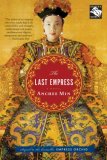
Anchee Min discusses Empress Orchid
You did extensive research for Becoming Madame Mao and lived
through the Cultural Revolution in China, which added a special intensity to
your descriptions. Did similar experiences inform Empress Orchid?
Details are extremely important to me. The most challenging thing has been to
get the facts and get them right. There are sometimes several contrasting
versions of a single incident involving Empress Orchid, and many sources are
false or inaccurate. I went through documents not only in the Forbidden City,
but also medical, accounting, and police records. My reading on the lives of
eunuchs, maids, palace tutors, imperial warlords, and generals helped me gain
crucial perspective. The Empress's food and herb manuals and her opera manuals
also revealed a lot about her character.
Remarkably, you and your father were able to gain access to documents in
government-guarded storerooms in Beijing. Would you describe how it happened?
Well, I had to get my hands on the facts, but no official in Beijing would risk
his career to open the door for me. So I tried the "back door." I can't say more
than this, because I don't want to get the person who helped me in trouble.
Anyway, I got in. The place where all the ancient documents are stored is
treated with strong chemicals, so I was told not to stay inside for more than
half an hour. But I didn't want to leave. I read the Empress's original decrees
(or copies of decrees, I can't be sure). I was choking on the fumes, but I was
glad I stayed. The evidence was compelling that she was a fitter ruler than
anyone else of that time. There was a reason her regime lasted for forty-six
years.
Your seamlessly real depiction of the Forbidden City transports the reader
inside its palaces and gardens. How was Orchid's life there defined — and
confined — by its traditions?
What affected her most was that she knew she was a woman, a concubine. Any wrong
move would cost her her life. The price of her survival was a lot of personal
sacrifice and suffering. For example, she was a passionate woman, widowed at the
age of twenty-six. From then on, she was forbidden to have a relationship with a
man. She had to fight her need for intimacy, denying her own humanity. As with
everything else in her life, such as her effort to revive China, she failed, but
her struggle was heroic. She kept China in one piece until she died.
What are Chinese schoolchildren taught about Empress Orchid? And how do
history books around the world remember her?
She was considered "the enemy of the human race." In China, children learn that
the collapse of every dynasty was the fault of the concubine. The execution of
the concubine justified whatever was wrong. That's the tradition. The most
recent example was Madame Mao. She was sentenced to death, while her husband was
seen as the George Washington of China. Children are taught that the Empress was
responsible for destroying China's two-thousand-year imperial culture. Chinese
and Western history books remember her negatively too, but the books provide
very few facts.
Empress Orchid and Madame Mao are both powerful personalities with a great
deal in common. What characteristics drew you to them, and do you share those
characteristics yourself?
I do. I am female and Chinese, and at a very young age I learned that my culture
disfavors females. Books hold up women as negative examples, such as Madame Mao
and Empress Orchid. I was drawn to them because I like to find out the truth. It
started with Red Azalea, my first book, about growing up
during the Cultural Revolution. The Chinese government's official version of the
Cultural Revolution contrasted with the life I had lived. I could not let the
lies be the only record. It scared me to think that my daughter would be
studying false history, and I felt obligated to do something about it.
Some of your writing is critical of China — past and present. Has the Chinese
government taken an "official position" on you? What has your experience been
when visiting your family in China each year?
China's policy toward me is "We don't want to make an enemy of Anchee Min, but
we don't have to promote her, either." My family in China has concerns. But as
long as there are no Chinese versions of my books, they feel safe.
The conclusion of Empress Orchid is "the end of the beginning" and
leaves your audience begging for a sequel. Can you give us an idea of what
happens next?
After she was widowed, Tsu Hsi ruled for forty-six years. The material about
this time is absolutely fascinating. She was forced to learn many things,
including diplomacy. Keep in mind that China in the late 1800s had been closed
to outsiders for more than two thousand years. Westerners were trying to force
their way into the opium trade. Meanwhile, domestic rebels, the Boxers, wanted
to overthrow the dynasty. The Empress performed a delicate balancing act, and as
a result she single-handedly held the dynasty together. My next book will reveal
more of her private character. She was a great politician, a clever strategist,
and a caring mother and lover.
Unless otherwise stated, this interview was conducted at the time the book was first published, and is reproduced with permission of the publisher. This interview may not be reproduced or reprinted without permission in writing from the copyright holder.
Anita Amirrezvani was born in Tehran, Iran, and raised in San Francisco. For ten years, she was a dance critic for newspapers in the Bay Area. She has received fellowships from the National Arts Journalism Program, the NEA's ... (more)
If you enjoyed:
Empress Orchid
Try:
The Blood of Flowers
by Anita Amirrezvani
Jasper Becker is a British author, commentator and journalist who has spent two decades as a foreign correspondent mostly in China. Becker has contributed features to Vanity Fair, National Geographic, Marie Claire, Travel & ... (more)
If you enjoyed:
The Last Empress
Try:
The Chinese
by Jasper Becker
We recommend 23 similar authors
The Stone Home
by Crystal Hana Kim
A moving family drama and coming-of-age story revealing a dark corner of South Korean history.

The House on Biscayne Bay
by Chanel Cleeton
As death stalks a gothic mansion in Miami, the lives of two women intertwine as the past and present collide.

The Funeral Cryer by Wenyan Lu
Debut novelist Wenyan Lu brings us this witty yet profound story about one woman's midlife reawakening in contemporary rural China.
Your guide toexceptional books
BookBrowse seeks out and recommends the best in contemporary fiction and nonfiction—books that not only engage and entertain but also deepen our understanding of ourselves and the world around us.