
-
Your next favorite book
is waiting.

How to pronounce Dinaw Mengestu: dih-now men-guess-too
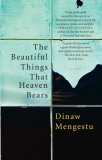
Dinaw Mengestu discusses many aspects of The Beautiful Things That Heaven Bears, a haunting and powerful first novel that views the streets of Washington, D.C. and Addis Ababa through the eyes of Sepha who, seventeen years ago, fled Ethiopia during the Revolution and now runs a failing convenience store in a poor African-American neighborhood in Washington.
How much of your own story and your family’s story is in
this novel? How did you learn about your family’s experience?
The novel is definitely a blend of fact and fiction. The parts
of the narrative that are true were told to me over the course of many years,
sometimes by accident, sometimes deliberately. As is often the case with
fiction, a certain factual detail becomes the starting point from which the rest
of the narrative takes off. My uncle, for example, was a lawyer in Addis, and he
was arrested and died during the government’s Red Terror campaign. The details
of his death, however, are entirely unknown to me or anyone else in my family.
Similarly, another uncle who was a teenager at the time did flee Ethiopia for
Sudan during the Revolution, and while we’ve discussed his journey, it’s always
in relatively vague and general terms, and that’s partly where the fiction
element comes. It allows you to create the details that can bring a story to
life.
Why do you think that the lives of African immigrants in the
United States have been so little explored in fiction until now?
There have clearly been dozens of wonderful novels written by
Africans about Africa. The African diaspora experience in America, however, is
still in its early stages, especially with Ethiopia. My generation is the first
to grow up in America, to know it well enough to write about it from "inside"
the culture, so to speak, and I imagine as the years go on, there will be plenty
of other similar narratives.
Although your book is written from the point of view of an
African immigrant from Ethiopia, it is also in a sense an African-American
novel, set in a primarily black neighborhood in Washington, D.C. Can immigrants
from Africa offer a new perspective on race relations in the United States?
I wouldn’t say that this is an African novel, or
African-American novel. To me, it’s a novel about America, with all of its
competing and sometimes conflicting identities. Of course, growing up black and
African in America has shaped my writing and experiences in more ways than I
could possibly state, and yet I have to argue for the singularity of my opinion
and perspective on this, which is to say I grew up and continue to live in
different communities, some predominately white, some predominately
African-American or African. Personally, for me, if there is a new perspective
on race relations that comes from being an African immigrant it stems from this
sense of never wholly identifying with one category.
More specifically, can you talk about some of the different
ways that African-Americans and African immigrants experience American society?
What is the relationship between the two communities like?
Obviously there is no simple or short answer to that question.
If anything though, I would have to say it’s easy for people not to understand
just how removed and disempowered many minority communities, particularly
African immigrants and African-Americans feel from the country’s power
structures, political, social, and economic. As for the relationship between the
two communities, like any two closely intertwined communities there is a give
and take, with ample room for misunderstanding and disappointment. In DC, for
example, many within the African-Americans community were angered at a proposal
to rename a part of the historically black U street corridor "Little Ethiopia."
That anger, of course, is entirely understandable, and in its simplest form,
comes out the question, whose experience in America matters more?
Sepha Stephanos, your narrator and main character, has a
very tentative romantic relationship with a white woman who moves in next door.
Are the barriers to their relationship primarily personal, racial, economic, or
some inextricable combination of all those?
In Sepha’s case, the barriers are very much a mix of all these
factors, but perhaps most important to the novel is that mix of race and
economics. I wanted to show how together the two can create vast, seemingly
inseparable gulfs between people. Recently much more attention has been paid to
the growing class and economic divide within America, and that divide, when
coupled with race, magnifies the tensions even more.
The neighborhood in which you set your story is Logan
Circle, which is rapidly being gentrified. More bluntly, prosperous white people
are moving in and bringing economic pressures to bear on the poor black people
who already live there. Can this sort of change ever go well?
Gentrification is one of those words in constant circulation
these days, not only in DC but also in New York and I’m sure many other cities
throughout the country. When it means mass displacement, the type of which is
happening throughout DC and New York, where entire communities are being turned
over, then no, I don’t think these changes ever really go well. At the same
time, however, there has to be room for economic revitalization and rebuilding,
the type that allows for a community to rebuild its own resources—schools,
homes, businesses—while allowing for new growth.
Judith, the white woman in the novel, is a professor of
American history, and one of her favorite quotation is from Tocqueville’s
Democracy in America: "Among democratic nations
new families are constantly springing up, others are constantly
falling away, and all that
remain change their condition; the woof of time is every instant
broken and the track of generations effaced." Does this quotation still describe
the essential dynamic of American society, for immigrants and native-born
citizens alike?
My interest with Tocqueville comes in large part from how
accurate I think many of his observations about America still are. Tocqueville,
while at times highly critical of America and its democratic spirit nonetheless
respected the country’s inherent dynamic nature. Families, language, all of
these are in a constant state of flux and evolution, which is a part of the
great American myth—and I don’t use that term pejoratively—that each individual
has the ability to change their circumstances, better their lives, and make
themselves an entirely knew man or woman. Of course that ties in directly with
one of the more common criticisms about America, which is its lack of regard for
history.
Do you think there’s something new about the latest wave of
American immigrants over the past few decades? Are their experiences in some
ways fundamentally different from the experiences of the European immigrants of
the early twentieth century, for example?
Obviously America’s ethnic make up is rapidly changing. The
Hispanic community has become the largest minority community in the country,
while at the same time there have been an ever-increasing number of African
immigrants. Undoubtedly their experiences are going to be different, while at
the same time, they will also be marked by some of the same burdens ranging from
discrimination to low-paying jobs.
What do you think your novel has to say to all Americans,
regardless of ethnic or racial background, about national identity?
I don’t know if novels are supposed to say anything. I think
they exist to complicate and expand upon our understanding of the world and it
is up to the reader to create their own personal meaning out of the narrative.
Is it ever possible for an immigrant to overcome the sense
of being stuck between two worlds that Sepha feels? How is it done? What is the
price that must be paid?
I’m sure many immigrants can and do overcome that sense,
although I can’t say I personally know any. I was born in Ethiopia but I’ve
grown up entirely in the United States and yet I’ve held on deliberately, at
times fiercely, to a country that I hadn’t seen in twenty-five years. Many other
immigrants I’m sure have a much stronger sense of the country they left behind
and so perhaps for them it has less to do with being stuck between two worlds as
it does with moving between two different realities. In Sepha’s case, Ethiopia
has been physically left behind and he lives with that absence and refuses to
let it go because nostalgia and memory are all he has.
Your title is taken from Dante’s Inferno. Can you
recite that passage and explain how it is related to your story?
The passage comes from the last few lines of the Inferno,
just as Dante is preparing to leave Hell. "Through a round aperture I saw
appear, some of the beautiful things that Heaven bears, where we came forth and
once more saw the stars." I read the Commedia as an undergraduate, and
then read parts of Robert Pinsky’s translation years ago. The last lines always
stuck with me, as many wonderful lines in poetry often do. In this particular
case it was the idea of beauty that struck me most. It’s an idea central to the
novel, and it’s a word repeated throughout the narrative. Dante still has not
made it to heaven yet, and won’t until passing through purgatory, and so there
is an ambiguity to the language. The beautiful things are not named or
described, and won’t be until Dante finally reaches heaven. And yet of course he
can see a hint of what that beauty is. He knows it’s there even if he has not
attained it. Joseph, one of the novel’s central characters, latches on to that
idea of a visible but not yet attained heaven as a metaphor for his
understanding of Africa.
Although your novel does not take place in a single day, Sepha goes on a crucial day-long journey through the streets of Washington that
inevitably calls to mind Leopold Bloom’s journey in Ulysses. Was that a
correspondence you were consciously seeking to evoke?
I wasn’t thinking of Ulysses explicitly while writing
this novel, although of course I was aware of Bloom’s one-day journey through
Dublin. The novel that probably proved the most influential in imagining Sepha’s
trip through Washington DC was Saul Bellow’s Herzog. I’m sure even
subconsciously the letters that Sepha reads were an echo of the letters that
Herzog is constantly writing in his head as he wanders through New York and his
own past.
Another work of literature that figures significantly in
the novel is The Brothers Karamazov, which Sepha reads to Naomi, Judith’s
bright young daughter. Are there thematic parallels between that work and your
own?
The Brothers Karamazov was one of those novels that once
read, never leave you, but I can’t say I chose it out of any obvious thematic
parallels. I’m not even sure I would ever want to think of the novel in terms of
thematic resonance. Alyosha’s speech that Sepha commits to memory at the end of
the novel does tie in with a lesson that Sepha wants to pass onto Naomi, and of
course himself, namely that we all seek some form of salvation from who we are
and what we’ve become and that it’s possible to find that salvation in a memory
of who we once were.
Sepha and his only friends, two fellow African immigrants
named Ken and Joseph, regularly play a sarcastic game together. One of them
names an obscure African dictator, and the others have to name his country and
the date of the coup that put him power. Why are they so bitter and hopeless
about their home continent?
I don’t actually think of them as being hopeless. Bitter, yes,
but if anything it’s a bitterness born out of love. If they did not love and
mourn for their home countries, and for the continent as a whole, they would
never spend so much time mocking and eulogizing Africa. They are all realists,
to one degree or another, and what they will not do is romanticize any of the
continent’s failures, most notably those of its leaders.
You recently wrote a major piece about the crisis in Darfur
for Rolling Stone, and you’re headed off now to Uganda on another
assignment. What’s your own view about Africa’s future?
I still see more hope and potential in Africa than I do despair,
and I say that after having seen it at its very worst. Part of why I went to
Darfur and now northern Uganda is because like many Africans, I was tired of
seeing the continent’s conflicts described as "hell," or "hellish." Yes, there
is more misery and suffering than any one person should ever have to bear, but
even in the case of Darfur, that is not the entire story. Underlying that misery
and violence are remarkable people who continue to endure and survive despite
their corrupt leaders.
When and how did you decide to become a writer?
I don’t think most writers ever decide to write. For me, it was
something that I did because I had to. It’s been my way of managing and making
sense of the world I live in.
Are you planning another novel yet? Can you describe what
it’s about?
I am working on another novel, but it’s in such an early stage
that I would hate to say what it will or will not become. I’m still figuring
that out, which is part of the joy of writing.
Unless otherwise stated, this interview was conducted at the time the book was first published, and is reproduced with permission of the publisher. This interview may not be reproduced or reprinted without permission in writing from the copyright holder.



Chimamanda Ngozi Adichie grew up in Nigeria. Her work has been translated into more than fifty-five languages. She is the author of the novels Purple Hibiscus, which won the Commonwealth Writers' Prize; Half of a Yellow Sun, ... (more)
If you enjoyed:
Someone Like Us
Try:
Americanah
by Chimamanda Ngozi Adichie
Bisi Adjapon is the author of The Teller of Secrets (first published as Of Women and Frogs), A Washington Post, Essence, ALA, Boston Globe, Ms Magazine's top 20 novel in November 2021. Her second novel, Daughter in Exile, was... (more)
If you enjoyed:
Someone Like Us
Try:
Daughter in Exile
by Bisi Adjapon
We recommend 29 similar authors







Happiness makes up in height for what it lacks in length.
Click Here to find out who said this, as well as discovering other famous literary quotes!

Can you name the title?
Test your book knowledge with our daily trivia challenge!
Your guide toexceptional books
BookBrowse seeks out and recommends the best in contemporary fiction and nonfiction—books that not only engage and entertain but also deepen our understanding of ourselves and the world around us.
