
-
Your next favorite book
is waiting.

Marisha Pessl discusses her first novel, Special Topics in Calamity Physics, which is structured around the syllabus of a Great Works of Literature class, and what inspired her to write it.
Special Topics in Calamity Physics is your first novel. What was the inspiration for this very original story? How and when did you begin writing it?
I began the book when I was twenty-four and, until I moved to London, lived something of a double life working as a financial consultant during the day and writing at night, sometimes all night. Given my tendency to fall asleep at my desk, my dazed and often nonsensical answers to my boss’s questions, I do think my coworkers suspected I was up to something—but were too afraid to ask what it was!
In terms of a germinating idea, I began with character—Blue’s voice first, then Gareth, the dynamic of father and daughter. Where I grew up in North Carolina, many children were home schooled, and I always found that so unusual and mysterious: what it would be like to have your parent quite literally your teacher, how powerful yet isolating it might be. On one hand, to have a gifted, multilingual professor tutoring you privately every day would be tremendous; intellectually you’d be leaps and bounds ahead of the other students. And yet you’d miss out on that very American,
Sixteen Candles schooling: the cliques, the cheerleaders, the plays, the P.E., Friday night dances in the cafeteria, slow-dancing with a clammy-handed kid to “Stairway to Heaven.” What kind of person would you become, how would you interact with the world, if, in that section of your life, you had a blank page? Blue tiptoes out of that question.
Blue van Meer is a great narrator, one whom the reader can trust but who undergoes a rapid evolution. What do you like most about her?
On the surface she’s quite shy and unassuming, perceives herself as something awkward and ordinary, totally camouflaged by her environment. And yet her inner life is Dickensian, teeming with incessant observations about people, her surroundings, the world, scientific theory, life, love. I like this juxtaposition, the idea that there are people moving through the world, people you wouldn’t look at twice, who are brilliant, painfully human, great. Blue really tries for the truth too—something else I like about her. She tries her utmost to be a reliable and judicious narrator, even though, given the calamitous events of her life, it’s nearly impossible. Unlike her father, she has no ego, and doesn’t mind how naïve, blind, or, most embarrassing of all, uncool she comes across in the narrative, which is more than you can say for other first-person narrators who don’t think twice about manipulating events simply to make themselves look good.
How did you get the idea for the Core Curriculum format? How much do individual chapters follow the plots and/or characters of their namesakes?
After I completed a first draft of the novel, I wanted to find an inventive way Blue would organize the many parts of her story. Unlike me, who (as you’d realize if you ever glimpsed the desk in my office—if it is a desk under there; one can’t be sure) doesn’t mind chaos, clutter, and pandemonium, Blue has a scientific mind; she loves order, classification, responsible and unambiguous labeling. I was interested, too, in how the books we read—those that are life-changing—stop belonging to the author but become our own in a way that has little to do with the actual narrative, themes, or characters. They take on a different life and meaning, one that is personal to the reader. When I first read To Kill a Mockingbird, for example, I was spending the summer with my family in Venezuela, and read the book sprawled on the stern of my uncle’s boat as we toured tiny uninhibited beaches off the coast. So whenever I hear the title, I think of that boat, the great
El Caramelo Cinqo, and the music, Juan Luis Guerra’s “Burbujas de amor,” the unseen threat of sharks and scorpions, how I couldn’t tear myself from the book to reapply sunscreen, ending up with the cruelest sunburn of my life—I picture all of this long before I picture Scout or Boo Radley. In this vein, the book titles of
Calamity Physics take on new and often humorous connotations informed by the events of each chapter yet remain rooted in their grand tradition as works of the Canon. It also felt like the appropriate choice for Blue because she filters every experience—even the harrowing and heart wrenching—through a certain book or two that she’s read. It’s her reassurance, how she’s able to absorb things. For readers inclined toward sleuthing, too, every section contains a clue hinting at the reason why Blue named each section what she did. Each chapter comprises a tiny mystery, so to speak, some obvious, others not.
Blue’s father, Gareth, is both seductive and a little unsettling. How did you manage to strike such a fine balance in tone while writing about him? Which of his traits do you find most attractive?
I didn’t think about this balance, actually. My intention as a writer was to make him—all of the characters—as fully realized and real as I could, to see them as people, with as many strengths and weaknesses as the rest of us. Gareth is magnetic, which has to do with his confidence and wit, but also the brazen way he voices his opinions. When it comes to what he believes—what he loves, hates—he doesn’t hold back, and this can be deeply attractive to other people, particularly in today’s world, where many are afraid to stand up, express themselves, go against the grain, be unpopular. History is full of men who can manipulate a crowd, inspire them to do jaw-dropping things, not by force, but simply by speaking. It’s a fascinating and unsettling phenomenon.
Names are important in this book, whether they be nicknames or alibis. Can you describe for us how you came up with the Blueblood’s individual and collective names? Why does the word blue—most obviously as a name, but also in describing cars and nights and eyes—recur so often? What significance does it have for you?
At the risk of sounding somewhat mystical, I simply go with my gut when I’m christening characters. I try to determine if the name matches the face and body of the person I see in my head. It’s very much like being a shoe salesman: you have to find the right pair of shoes for them to walk around in. They can’t be too big, flashy, or impractical. (If there’s one thing I hate in novels is when a character who has buggy eyes and walks hunched over with a cane has a name like Bulge E. Stoops.) The name must fit just right, be comfortable, practical for the long haul, yet in accordance with their style and personality. Funnily enough, I wasn’t a huge fan of “Hannah Schneider,” but every time I tried to change it, it felt so outrageous and wrong, I had to change it back. Nothing else worked for her. She really wanted to wear those rather ordinary shoes—so I let her.
Certainly, if the book had an overriding hue, a lens through which we’d see all the characters and events, it would be dark blue, implying beauty, sadness, and secrecy. Apart from countless cultural connotations of the color—singing the blues, Picasso’s Blue Period, blue sky (happiness, but also a knack for creating something from nothing)—it signifies morality and strength, two of Blue’s prevailing qualities.
The book ends with a lot of unanswered questions. We’d love it if you could tell us the correct answers to the quiz at the end! Any hints?
Having suspected some readers will hope they can e-mail me, entreat to my softer side, get me to clarify everything using Excel spreadsheets and flow charts, I’ve sadly decided no reader can know more than Blue. It wouldn’t be fair if you were able to go over her head and speak directly to the Chairman of the Board. I will say, however, that all information you need for the Final Exam exists between the covers of the book, so it’s possible you can piece the puzzle together better than she can. You might find something she’s missed—or only pretended to miss.
What books or authors have been particularly influential in your life?
Like Blue, I spent my childhood reading big, dense books, from the Victorian to the Russian to the Gothic to the American Modernists. I love good old-fashioned storytelling, writers who spin a haunting tale, mastering character and plot, crafting a detailed world you can, as a reader, disappear into for days on end—Dickens, Austen, the Brontë sisters, Dostoyevsky, Fitzgerald, Hemingway, Tolstoy. At the same time, I love language and am inspired by contemporary writers who are genius wordsmiths at the sentence-by-sentence level: Chabon, Franzen, Eugenides. Charles D’Ambrosio is also pretty dazzling.
I think every writer has another novelist who’s bewitched them, and in my case (it will come as no surprise, as his giant shadow drifts in and out of
Calamity Physics), it’s Nabokov. He mastered everything I’m secretly zealous about, writing-wise: every sentence glows, his plots are flawless, descriptions gaspingly real, themes—the sadness of exile, obsessive love, childhood, problems of knowledge and memory—always relevant. He was in such control of his narratives, he had time to construct cat-and-mouse games for his readers. His books are civilizations you can mine endlessly (if you’re into that kind of thing) and intellectualized entertainments (if you’re not).
Will we see more of Blue van Meer in future work? Are you working on a second novel?
I am working on my second novel, filled with new locations and new characters, so I don’t think Blue (or Gareth, for that matter) will make an appearance. I do suspect in future books one of them will appear—even if it’s just a Hitchcock cameo.
Unless otherwise stated, this interview was conducted at the time the book was first published, and is reproduced with permission of the publisher. This interview may not be reproduced or reprinted without permission in writing from the copyright holder.


Margaret Atwood is the author of more than fifty books of fiction, poetry, and critical essays. She has won the Booker Prize, the Arthur C. Clarke Award for Imagination in Service to Society, the Franz Kafka Prize, the Peace ... (more)
If you enjoyed:
Night Film
Try:
Stone Mattress
by Margaret Atwood
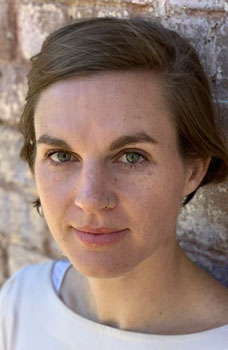
Ava Barry was a script reader for Bold Films and Intrigue Entertainment, and an editorial assistant for Zoetrope: All-Story, Francis Ford Coppola's literary magazine. Windhall is her first novel. She lives in Australia. (more)
If you enjoyed:
Night Film
Try:
Windhall
by Ava Barry
We recommend 34 similar authors


I have always imagined that paradise will be a kind of library
Click Here to find out who said this, as well as discovering other famous literary quotes!

Can you name the title?
Test your book knowledge with our daily trivia challenge!
Your guide toexceptional books
BookBrowse seeks out and recommends the best in contemporary fiction and nonfiction—books that not only engage and entertain but also deepen our understanding of ourselves and the world around us.

