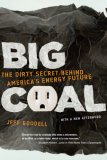
A Conversation with Jeff Goodell about Big Coal: The Dirty Secret Behind America’s Energy Future which debunks the faulty assumptions underlying coal's revival and shatters the myth of cheap coal energy.
Why did you decide to write a book about coal?
In the spring of 2001, the New York Times Magazine sent
me down to West Virginia to write about the comeback of the coal industry. Coal
had played an important role in the election of George W. Bush in 2000 — West
Virginia, an important coal state which hadn’t voted Republican in many years,
was widely credited with giving Bush his margin of victory — and it was clear
that coal would play an increasingly important role in America’s energy future.
But visiting West Virginia was an eye-opening experience for me, in part
because, like many Americans, I’d naively assumed that coal had gone out with
top hats and corsets. I was astonished to learn that the United States burns
more than a billion tons of coal a year, mostly to generate electricity. More
than half our electric power comes from coal-fired power plants. In West
Virginia, I got a close look at the high cost of our dependence on coal — not
just the hundreds of square miles of mountains that have been decapitated by
strip mines in the southern part of the state, but also the poverty and hardship
that I witnessed in many coal-mining towns. I began to ask some obvious
questions: Why is the richest, most powerful nation on earth still burning black
rocks for power? Why is it that we’ve figured out how to unravel DNA, clone
sheep, and build a global communications network that allows me to send a photo
of my dog to a friend in China in a few seconds, but we can’t figure out a way
to generate electricity that doesn’t wreck the planet?
How much coal does America have?
A lot. The coal industry likes to call America "the Saudi Arabia
of coal." The U.S. Department of Energy’s official estimate of recoverable coal
is about 270 billion tons. At the rate we’re going, that’s enough for about 250
years. The question is, what will it take in economic, environmental, and human
terms to get that coal out of the ground? We’ve been mining coal in America for
more than 150 years now — all the easy-to-get stuff is gone. Much of the coal
that’s left is of poorer quality or it’s in thinner, more deeply buried seams.
Getting it out is not only more environmentally destructive, but more dangerous,
too.
How safe is coal mining?
That’s like asking how safe it is to be a police officer. If
you’re patrolling a shopping mall in Beverly Hills, you probably don’t have much
to worry about. If you’re working on an undercover drug sting in the Bronx, you
had better be ready for anything. Similarly, driving a haul truck in a big strip
mine in Wyoming’s Powder River basin is no more dangerous than any other job
involving heavy machinery. But if you’re cutting coal in a small, underground
mine in Appalachia — miners call them "dogholes" — the odds that you’ll be hurt
or killed increase dramatically. In fact, according to the U.S. Department of
Labor, mining is still one of the most dangerous jobs in America, and working in
a small underground mine is one of the few jobs that is nearly as dangerous as
commercial fishing in Alaska. In addition, hundreds of miners still die each
year from black lung — a devastating disease that should have been eradicated
long ago.
What is "clean coal"?
It’s a promotional slogan designed to help spiff up coal’s image
from a relic of the nineteenth century to a viable fuel source for the
twenty-first century. But all you have to do is spend a few hours in southern
West Virginia, where coal mining has blasted away the mountains and old men sit
alone in diners gasping for air with coal-blackened lungs, to understand that
"clean coal" is not just an oxymoron, but an insult to the very real suffering
that our dependence on coal causes.
That said, it’s indisputably true that the coal-fired power
plants that are being built today are much cleaner than the coal plants that
were built thirty years ago. And the electric power industry is rightly proud of
the progress that has been made in many parts of the country when it comes to
cleaning up the air. Despite these improvements, however, the American Lung
Association estimates that 27,000 people a year still die prematurely as a
result of pollution from coal-fired power plants. Coal-fired power plants are
also the largest emitters of mercury in the United States, releasing forty-eight
tons of this potent neurotoxin each year. Combustion wastes from coal plants —
fly ash, scrubber sludge — are also a significant environmental and public
health concern.
But the biggest problem with touting "clean coal" is that it
ignores the elephant in the room: carbon dioxide, the main greenhouse gas that
is responsible for global warming.
How large a role does coal play in global warming?
Coal is the most carbon-intensive of all fossil fuels, and it is
not an overstatement to say that 200 years of coal burning by industrialized
nations is largely responsible for the fact that carbon dioxide levels in the
earth’s atmosphere are higher than they’ve been in the past 650,000 years.
Today, about 40 percent of the U.S. emissions of carbon dioxide come from
burning coal. To put that in perspective, one big coal-burning power plant I
visited in Georgia emits about four times as much carbon dioxide as all the cars
and trucks built by the Ford Motor Company in a single year. More important, if
the new generation of combustion coal plants that are being planned right now —
not just in the United States, but also around the world — actually get built,
we can pretty much kiss the chances for a stable climate goodbye.
Fortunately, there are better ways of extracting energy from
coal. One emerging technology, which gasifies coal rather than simply burning
it, might someday allow carbon dioxide to be captured and sequestered in
underground reservoirs. But of the 120 or so new coal plants that are currently
being planned in the United States, only a handful use this technology.
Can coal help us reduce our dependence on oil from the Middle
East?
To some degree, perhaps. Right now, most coal consumed in
America is used for electricity generation — which really has nothing to do with
oil from the Middle East. But there is a growing in interest in so-called coal
refineries that can transform coal into synthetic diesel fuel. (For chemical
reasons, coal can’t be easily transformed into synthetic gasoline.) The
technology is well established — it was pioneered, in fact, by the Nazis during
World War II. But there are major drawbacks. Even a small refinery costs
billions of dollars to construct. In addition, depending on the type of
technology that is used, coal refineries can result in even higher greenhouse
gas emissions than diesel fuel that is brewed in a traditional refinery.
Investment in coal refineries also takes money and interest away from more
sustainable and creative solutions to dependence on oil from the Middle East,
such as plug-in hybrid cars and biofuels. This does not mean that coal
refineries are necessarily a bad idea. It just means that they’re not a cheap or
easy solution to America’s energy problems.
In the epilogue of your book, you call the coal industry "an
empire of denial." What does that mean?
The main reason we’re still burning over a billion tons of coal
in America today is that the coal industry has been tremendously successful at
keeping us ignorant about what goes on behind the light switch. It has worked
hard to preserve the illusion that electricity flows down from a golden bowl in
the sky, and that there is no link between America’s appetite for power and the
millions of children in America who suffer from asthma, or the devastated
mountains of West Virginia, or the fact that global warming threatens the
stability of the earth’s atmosphere. In this sense, the comeback of coal is a
political story. It’s about keeping America in the dark about what it takes to
keep the lights on. I think that’s one reason why the recent deaths of fourteen
coal miners in West Virginia was so disturbing to many people. Coal miners labor
underground, often in extremely dangerous and difficult conditions, so that the
rest of us can crank up our heaters and air conditioners.
The truth is, the world faces two enormous challenges in the
coming years: the end of cheap oil and the arrival of global warming. Both are
profound threats to our comfortable notions of civilized life. We should be
grateful for the vast reserves of coal we have left and use them wisely, but
it’s important to recognize that our bounty of coal is not going to save us from
anything. At best, exploiting our coal reserves will buy us a decade or two of
time and come at enormous expense, both in terms of the environment and public
health and in terms of the billions of dollars that will be invested in a fuel
source that is, at best, a short-term solution. In many ways, the world’s coal
reserves only make our energy problems worse, because they give us a false sense
of security: If we run out of gas and oil, we can just switch over to coal; if
we can figure out a way to "clean" coal, we can have a cheap, plentiful source
of energy. In reality, however, facing the twin challenges of the end of oil and
the coming of global warming is going to require reinventing the infrastructure
of modern life. The most dangerous aspect of our continued dependence on coal is
not what it does to our lungs, our mountains, or our even climate, but what it
does to our minds: it preserves the illusion that we don’t have to change our
thinking.
Unless otherwise stated, this interview was conducted at the time the book was first published, and is reproduced with permission of the publisher. This interview may not be reproduced or reprinted without permission in writing from the copyright holder.


Poet, essayist, and naturalist, Diane Ackerman is the author of many highly acclaimed works of nonfiction, including A Natural History of the Senses -- a book beloved by readers all over the world and the volumes Deep Play, A... (more)
If you enjoyed:
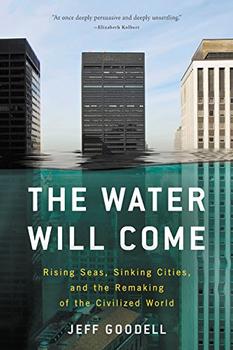
The Water Will Come
Try:
The Human Age
by Diane Ackerman

Dani Anguiano writes for the Guardian and was formerly a reporter for the Chico Enterprise-Record, where she covered Butte County, including Chico and Paradise. Having lived in Butte County for a decade, Anguiano now resides ... (more)
If you enjoyed:
The Water Will Come
Try:
Fire in Paradise
by Dani Anguiano
We recommend 23 similar authors





The Flower Sisters
by Michelle Collins Anderson
From the new Fannie Flagg of the Ozarks, a richly-woven story of family, forgiveness, and reinvention.

The House on Biscayne Bay
by Chanel Cleeton
As death stalks a gothic mansion in Miami, the lives of two women intertwine as the past and present collide.

The Funeral Cryer by Wenyan Lu
Debut novelist Wenyan Lu brings us this witty yet profound story about one woman's midlife reawakening in contemporary rural China.
Your guide toexceptional books
BookBrowse seeks out and recommends the best in contemporary fiction and nonfiction—books that not only engage and entertain but also deepen our understanding of ourselves and the world around us.