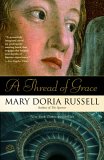
Mary Doria Russell talks about her extraordinary novel, The Thread of Grace.
I am a big fan of your novels. What took so long for a new one?
I've become a dues-paying member of the sandwich generation while writing
this book. Like many Baby Boomers, I'm helping elderly and infirm relatives
through illnesses and bereavement, just as my teenage son is learning to
drive, starting to date, getting his heart broken, applying for summer jobs
and college. My own health did a power-dive, and that episode took a two-year
chunk out of my life. Thank God, my husband has been healthy all this time, so
the household has run fairly smoothly!
Even without all that, A Thread of Grace would have been a bear. None of
the characters are American, and the story is set in World War II Italy, so I
am not drawing on my own language, culture or personal experiences at all. A
dear friend advised me to finesse the issue: "Just have everyone say Ciao a
lot and eat pasta!" But WWII is living memory and a topic of lively
scholarly interest. There will be plenty of reviewers and readers who'll
notice mistakes. And I feel a great responsibility to the people who entrusted
their memories and personal stories to me. So I've tried to get every
miserable little detail right, but I'm sure errors have slipped through.
Why World War II? Why Italy?
I am a Jew by choice and Italian by heritage. Shortly after I converted to
Judaism, I came across a book by Alexander Stille called Benevolence and
Betrayal: Five Italian Jewish Families Under Fascism. My first reaction was, "Italian Jews? I thought I was the only one! What do they eat? Lox parmesan?"
There was a section called "The Priest, the Rabbi and the Aviator," which
sounds like the set up for a joke, right? But it was all real, and riveting,
and I thought, "This has got to be my next story."
Everything in that book fascinated me. The oldest continuously existing
Jewish community in Europe is in Rome. Fascism was invented by Mussolini, and
Italy was Germany's ally, but Nazis occupied Italy for 20 months after the
Italian government made a separate peace with the Allies in 1943. And the
highest Jewish survival rate in Nazi-occupied Europe was in Italy! We've
spent 60 years trying to understand what went wrong during the Holocaust. I
wanted to know what went right in Italy.
Many of the characters in A Thread of Grace have faith and believe in the
religious foundations laid when they were young. What does war do to their
faith?
Yes, each character is endowed with an ethical framework that's challenged
at every moment and, in my books, no good intention ever goes unpunished.
Sometimes the character fails to live up to his faith's ethics. Sometimes
the character does everything right, only to be confronted with impossible
choices. They all judge themselves, and hold themselves accountable. In Italy,
you don't hear the Nuremberg refrain, "I am not responsible." There's
an Italian saying that counters that: "If you can help, you must help."
Italians did, and they paid the price.
How did you decide on which characters in A Thread of Grace lived and which
died?
So many survivors tell us it was blind, dumb luck, not heroism or decision
that got them through the war. I wanted that element of chance in the story,
so I had my son flip a coin. Heads, the character lived. Tails, the character
died. How and why and when–that was up to me as the storyteller.
How historically accurate is the novel?
Trust me: the most unbelievable things I write about are directly from
interviews I did with rescuers and survivors and veterans, here and in Italy.
Hannah Arendt wrote that evil was banal in the Third Reich, but in Italy
goodness was banal. In six years of research, I've yet to find a single
instance where an Italian ratted out a Jew in hiding. Making that goodness
believable to cynical modern Americans was the challenge! Early readers kept
telling me, "Oh, the Italian peasants are too nice to the refugees. The
soldiers are too decent." So the fiction was that I toned down the decency
or provided a motive for what was actually an unquestioning hospitality
extended to strangers.
How did you integrate the history with your imagination?
I thought of it as constructing a fictional building with real bricks. Anyone
who's familiar with Genoa and Cuneo and Borgo San Dalmazzo during the 1940s
will recognize events I describe, but I wanted the freedom to imagine the
emotions and conversations of my characters, so I mixed elements of various
real people's stories and assigned them to characters of different gender or
age or nationality. I used memoirs and historical accounts of skirmishes and
battles, and placed them in a fictional geography embedded in the real
timeline of the war. That kind of thing.
I noticed that the characters in A Thread of Grace are of all ages,
genders, religions, and ethnicities. Was this intentional?
Well, it's about Europe during a period in which millions of people were
displaced and in which there was no longer any distinction made between
combatants and civilians. War stopped being a young man's experience.
Beginning with Guernica, civilian populations were targeted on purpose. It was
shocking then, and remains contemptible and tragic, but it's standard
operating procedure in modern conflict. We don't have battles between armies
anymore.
Like your previous novels, A Thread of Grace exists in a very morally
ambiguous universe. Is war the cause of ambiguity? Or is that just human
nature?
I could probably make a theological case that God is the cause of moral
ambiguity–give a species free will, and look what happens! The thing about
novels is that they're a good tool for showing how point of view changes
what's good and what's bad.
What was your favorite piece of research you uncovered while writing the
book?
Finding out that Renzo Leoni would have flown a Caproni 133 triple-engine
high-wing fighter-bomber during the Abyssinan War of 1935-36. Took weeks to
track that detail down, but it was important.
Your first two novels were literary science fiction. What made you choose
to write historical fiction for your new novel?
Actually while I was writing The Sparrow, I thought of it as a historical
novel that takes place in the future. Whether I was going forward 60 years or
back in time 60 years, there was still a need to imagine a place and time that
aren't my own.
I can't tell you the number of times I've asked myself, "Jeez, Mary,
would it kill you to write a story with a middle-aged Ohio housewife as the
narrator?" But I don't seem to be interested in writing what I know. I write
what I don't know, and what I want to learn about.
Would you call A Thread of Grace an anti-war novel?
I wrote it to understand why war is perennial. What's the payoff? Why are
some men attracted to it, generation after generation? I wanted to make it
comprehensible. Wars always seem to start for two reasons: to redress a past
injustice and to restore lost honor. Inevitably, wars create new injustices
and a different honor is lost. Each war is begun in hope and ends in despair,
and each one carries the seeds of its successor. Understanding that depresses
the hell out of me.
On the other hand, when the whole world appears to permit and reward the
basest and most awful of human impulses, acts of decency and goodness are like
gems in a dung pile. When else would the simple act of sharing a meal rise to
the level of magnificence and courage?
Copyright Doubleday Broadway. Reproduced by permission of the publisher.
Unless otherwise stated, this interview was conducted at the time the book was first published, and is reproduced with permission of the publisher. This interview may not be reproduced or reprinted without permission in writing from the copyright holder.


Ramona Ausubel is a graduate of the MFA program at the University of California, Irvine. She is the author of the novel No One Is Here Except All of Us and the short story collection A Guide to Being Born. Her work has been ... (more)
If you enjoyed:
A Thread of Grace
Try:
No One is Here Except All of Us
by Ramona Ausubel

David Benioff (born David Friedman but changed his name to take his mother's maiden name) was born and raised in New York City and attended Dartmouth College and the University of California at Irvine. His father, Stephen ... (more)
If you enjoyed:
A Thread of Grace
Try:
City of Thieves
by David Benioff
We recommend 16 similar authors




The House on Biscayne Bay
by Chanel Cleeton
As death stalks a gothic mansion in Miami, the lives of two women intertwine as the past and present collide.
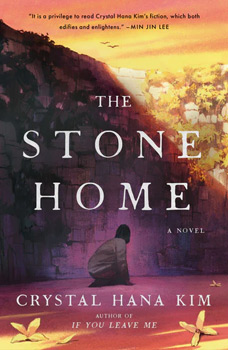
The Stone Home
by Crystal Hana Kim
A moving family drama and coming-of-age story revealing a dark corner of South Korean history.

The Funeral Cryer by Wenyan Lu
Debut novelist Wenyan Lu brings us this witty yet profound story about one woman's midlife reawakening in contemporary rural China.
Your guide toexceptional books
BookBrowse seeks out and recommends the best in contemporary fiction and nonfiction—books that not only engage and entertain but also deepen our understanding of ourselves and the world around us.