
-
Your next favorite book
is waiting.
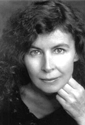
Margot Livesey explains why she chose to write about a romance between a man with Asberger's Syndrome and a radio show host, and what she learned from looking at the world from Zeke's very different viewpoint.
Where did the idea for this novel come from?
In 1998 I read a story in the newspaper about a Scottish student who
came to Miami for his summer holidays, was mugged and ended up trying to rob a
bank. Something about the young man's bewilderment, his parents' dismay,
crystallized two long held writerly ambitions: to depict someone who saw the
world differently and to explore the difficulties of knowing another person. I
sat down almost at once and wrote what became the first chapter. I then set it
aside for almost two years while I worked on Eva Moves the Furniture.
When I returned to my pages I realized at once that my character, Zeke, would
never rob a bank and that I was also writing a love story.
The book's narration alternates effortlessly between the
point of view of a young man with a personality disorder and the point of view
of a female, pregnant radio show host. How did you cultivate these two very
different voices and was it difficult to switch back and forth, writing from
both perspectives?
Switching back and forth between Zeke and Verona was
one of the great pleasures of writing the novel. I loved trying to understand
the world from Zeke's particular angle. What do we actually see when we say
someone looks surprised? What is it like to take the world literally? My
research was very helpful but so was remembering my own rather solitary
childhood when I often struggled to grasp the nuances of social interaction. As
for Verona, I loved that she was so strong-willed and confident and yet in
certain ways quite vulnerable. I won't comment on which characteristics I
share with her.
Zeke and Verona are unusual characters and they have unusual
names to match. Was this deliberate? How did you decide on these names?
I did want Zeke and Verona to have distinctive names
and, at the same time, ones you could easily pronounce. Zeke is named after a
distant acquaintance, a young man with peculiar hobbies; something about the
mysterious consonants "z" and "k" seemed just right. Verona
is named, I hope not too blatantly, after the Italian city where Romeo and
Juliet lived. Again I liked the sound of the word.
Zeke suffers from Asperger's Syndrome, a high-functioning
form of autism. Do you have a particular interest in this disease? If so, why?
My interest in Asperger's began more than a decade ago
when the son of a friend was diagnosed. Since then, over the years, I've
watched him grapple with the gifts and liabilities of his condition. I was
particularly interested in how he had to painstakingly learn things that most of
us take for granted – how to recognize a smile or a frown, for example – and
how he couldn't tell lies. I think part of why Asperger's is so fascinating
is that certain aspects of the condition are simply a more intense version of
what many of us experience. Hasn't everyone at times felt baffled by some
conversation or interaction? Don't we all occasionally feel hopelessly inept
and long to retreat from the complexities of the world? And, on the other hand,
don't we all occasionally long to be utterly focused? People with Asperger's,
by their very obliviousness, hold up a lens to our society and allow us to see
it and ourselves in a new way.
At the same time, watching my friend's son, I came to the
conclusion that a number of older men I know – one collects bus tickets,
another is a violinist with no time for non-musical matters – probably have
Asperger's but were born too early to be diagnosed.
What sort of research did you do to learn more about Asperger's,
and for the novel in general?
I read books about Asperger's Syndrome and talked
to people who have this condition, and to their families and friends. Several
radio show hosts helped me to get a clearer sense of Verona's job and I
consulted with a solicitor and various business people to make sure that I
understood Henry's machinations. Happily I already knew quite a lot about
painting and decorating from owning a ramshackle house in London for many years.
And I'm something of an expert on transatlantic travel.
Zeke and Verona spend one night together, fall in love, and
are separated almost immediately. It seems a bit far-fetched for each to develop
such strong feelings in such a short amount of time, but you make their
connection believable. How do you think you managed to pull this off?
Although we live in an age of skepticism, most
people still believe in the idea of love at first sight, or at least they want
to. Also, by beginning the novel in Zeke's head, I was able to show exactly
how smitten he is with this mysterious woman. Only when we're already on his
side, wanting things to work out, do we start to realize how unlikely this
attachment is and how many obstacles there are.
Several of the secondary characters in Banishing Verona cause
Zeke and Verona quite a bit of stress: Zeke's mother and father, Verona's
brother and her best friend. Yet despite the problems they create, they are
difficult to dislike. How were you able to make these often selfish and
sometimes uncaring characters likeable?
I've long been impressed by how hard it is to
dislike someone, in life or fiction, when they admit to their own bad behavior.
My characters don't necessarily "confess" as such, but I do allow
the reader to see that each of them, however self-centered, is operating out of
his or her deepest longings and desires. I think this makes it hard to stand in
judgment.
Are there certain books or writers that have been important
influences on your work?
Too many to name. In Banishing Verona I owe a
considerable debt to Rebecca West's brilliant novel The Fountain Overflows.
And I think you can also see the influence of many years of reading and watching
Shakespeare. I'm always struck by his fast moving plots, his commingling of
good and evil, and his belief in second chances.
Unless otherwise stated, this interview was conducted at the time the book was first published, and is reproduced with permission of the publisher. This interview may not be reproduced or reprinted without permission in writing from the copyright holder.

Jill Bialosky is the author of four poetry collections: The Players; The End of Desire; Subterranean, a finalist for the James Laughlin Award from the Academy of American Poets; and Intruder, a finalist for the 2009 ... (more)
If you enjoyed:
Banishing Verona
Try:
The Prize
by Jill Bialosky

Nickolas Butler was born in Allentown, Pennsylvania, raised in Eau Claire, Wisconsin, and educated at the University of Wisconsin-Madison and the University of Iowa Writer's Workshop. His first novel was the internationally ... (more)
If you enjoyed:
Mercury
Try:
The Hearts of Men
by Nickolas Butler
We recommend 21 similar authors



Judge a man by his questions rather than by his answers.
Click Here to find out who said this, as well as discovering other famous literary quotes!

Can you name the title?
Test your book knowledge with our daily trivia challenge!
Your guide toexceptional books
BookBrowse seeks out and recommends the best in contemporary fiction and nonfiction—books that not only engage and entertain but also deepen our understanding of ourselves and the world around us.
