
-
Your next favorite book
is waiting.

Liza Ward, whose grandparents were two of the victims of the Charles Starkweather and Caril Ann Fugate murder spree in the late 1950s, discusses which parts of Outside Valentine are based on actual research and what is entirely fiction.
Your book is centered on the Charles Starkweather killing spree that
happened in 1957, before you were born. What drew you to this particular
story? What inspired you to write Outside Valentine?
In January of 1958, while my father was at boarding school on the east
coast, Charles Starkweather and Caril Ann Fugate pushed their way into my
grandparents' home and murdered them. My great aunt and uncle became my
father's legal guardians and moved into the house where he had had grown up. I
used to visit them in the summers, never making the connection that such
horrible things had happened inside those walls.
For so long I was consumed by my grandparents' death. The nature of their
death was the only thing I knew about my father's parents. This tragedy cast a
heavy silence over my family. No one ever talked about who they had been. I
spent a great deal of time hungrily combing books searching for any sort of
detail that would bring me closer to understanding what had happened. I tried
to remember the carpets at my great aunt's house, the arrangement of
furniture, the arrowheads my father had collected as a boy, wondering if the
murderers had noticed, run their fingers over all these particular things, and
thought twice about the lives they were about to destroy. All those books I
read didn't provide any answers. They could never have possibly been enough.
There really isn't any way to make sense out of a random act of brutality. So,
Outside Valentine is my attempt at understanding how tragedy affects us, tests
our moral fiber, our strength, and never leaves us alone.
At its core, Outside Valentine tells the story of how violence and tragedy
can tear us apart. But you also depict how it's capable of bringing us
together. Was it difficult to strike this balance?
Yes, it was difficult. I wrestled with the notion of how to glean meaning
and value from something so thoughtless and ruthless. How could I bring it to
the next level, instead of making this story into a dictionary of bloody
events? And then it was a strange thing. At first the terrible events that
transpired in this country made me feel as if I had nothing to say. What was
the point? Who was ever going to hear our voices? Then, when the initial shock
wore off, I found that I couldn't stop writing. What was remembered in the
aftermath, the spirit and the fight in people who had lost loved ones was
inspiring. The way they clung to their memories, turned them into glittering
jewels was heartbreaking and profound. My character Lowell came to me. He is
forced to remember what he has tried to shut out for all his life, and I found
myself trying to make peace with my own family's past.
How much of Outside Valentine is based on actual research you did into the
Starkweather murders and how much is entirely fiction?
I did do some research into the murders for my own sake long ago because I
wanted to know what had happened, and when I began this project, I read more
closely. I read a few books, and articles from newspapers at the time. None of
them really got into the character of Caril Ann Fugate. She came out of me in
a way, out of any teenage girl. In writing this, I never allowed myself to be
hindered by actuality. When the facts suited my needs, I used them. At times I
found my own story, the made up part oddly mirroring the real story, detail I
never could have known, which is an odd sensation-many parts seemed to write
themselves. Of course no one survived to tell us how the horrible events
unfolded. I had to imagine that, which was a strange experience.
How has your family reacted to your book?
They have always been supportive of my writing, and supportive of this
endeavor, though it must be difficult in many ways for my father. He never
wanted to talk about his parents, and now characters inspired by them appear
on paper. He has been more generous than is humanly possible, and perhaps in
some ways it is a relief to talk about what was hidden away for so long.
The story seamlessly weaves together three voices and three different time
periods. Was this a stylistic decision you made from the outset?
I always wanted to write something about what had happened to my family in
Nebraska, but I never knew how I was going to do it. And then my novel sort of
took me by surprise. I started writing a story about Caril Ann Fugate for a
class in graduate school. It was nothing I thought I'd ever do--give a voice
to someone who I believed had no right to be heard, but I started to wonder
how a fourteen-year-old girl could get herself into a mess like Charlie
Starkweather. It was not entirely impossible to imagine, and suddenly I
couldn't stop imagining it. Like any teenage girl, she was desperate to be
recognized and loved. She didn't understand that she had a choice in matters,
that there is always a choice. Then I wrote a story about Susan, a girl living
in Lincoln at the time of Starkweather's electrocution, struggling with some
of the same issues. By the time I got to Lowell, the antiquities dealer
leaving his wife and going to open a mysterious box, I realized that these
voices were all connected. Now I feel that the events could not have been told
any other way. To me, a story is never just one story. It is a collision of
different voices. I've forgotten who said that history is put into motion by
opposition. It seems to me that novels are much the same.
Charlie Starkweather and Caril Ann Fugate's shocking crimes have been
fictionalized in several movies including "Badlands" and
"Natural Born Killers". What do you hope readers take away from your
own version?
I hope that readers will come away with an understanding of the long term
effects of these crimes, not just on the immediate survivors, but on removed
generations. So many movies and books seem to glorify Starkweather by giving
him exactly the sort of James Dean rebel without a cause persona that would
have pleased him so much. They touch on the cult aspect of this killing spree
in the media, or the factual aspects of the case, or what lead Starkweather to
commit these horrible crimes. The fact that real lives were lost and people
actually suffered never seems to be acknowledged. I too have explored the
almost romantic excitement the murders generated in those not directly
involved, but I have also tried to go a bit further in exploring how it might
feel to be closely related to people who are suddenly no longer there. Painful
memories do not disappear simply because they are not acknowledged. The past
haunts us, and yet I hope readers will come away with a feeling of hopefulness
about the future.
You've written short stories, some of which have appeared in The Atlantic
Monthly. Which do you prefer, the short story or the novel?
That is hard to say. Two years ago, my answer would have been most
definitely the short story. There is a special beauty and tightness to the
short story, a moment during which the world comes into a new sort of focus,
and the reader is left feeling changed. But a novel sweeps you up and holds
you close for a long time. It becomes more real and true than the actual, and
there is something both frightening and gratifying about being so caught up in
other voices.
Who has been the biggest influence on your work?
I can't really point to any specific writers, though I love so many. I love
Alice Munro. I love Faulkner. Perhaps I was influenced by Faulkner's idea that
the past is always with us, but when I tried to write like him, it was an
utter disaster. And so I would have to say music. Any good song that has
something important to say. I often listen to music while I write. Listening
to Bruce Springsteen helped me come to Caril Ann. So many of his songs have
stories, and there is a mournful steeliness to much of his work that I find
appealing and artistically inspiring.
What is next for you?
I have begun work on a second novel inspired by the other side of my family,
my mother's side, the New Englanders. I'd also like to get back to writing
short stories along the way. That is something I miss very much. I've also got
a wedding to plan and a house to build in Montana at the foot of a mountain
range. I am expecting to spend some time living in a tipi, with a phone pinned
to a tree. You can't write without living is what people say, and I believe
them.
Unless otherwise stated, this interview was conducted at the time the book was first published, and is reproduced with permission of the publisher. This interview may not be reproduced or reprinted without permission in writing from the copyright holder.

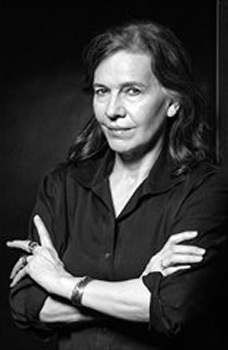
Louise Erdrich, a member of the Turtle Mountain Band of Chippewa, is the award-winning author of many novels as well as volumes of poetry, children's books, and a memoir of early motherhood. Erdrich lives in Minnesota with ... (more)
If you enjoyed:
Outside Valentine
Try:
The Round House
by Louise Erdrich

William Kent Krueger is the award-winning author of a dozen Cork O'Connor novels, including Northwest Angle and Trickster's Point, as well as the novel Ordinary Grace. He lives in the Twin Cities with his family. (more)
If you enjoyed:
Outside Valentine
Try:
Ordinary Grace
by William Kent Krueger
We recommend 5 similar authors




Finishing second in the Olympics gets you silver. Finishing second in politics gets you oblivion.
Click Here to find out who said this, as well as discovering other famous literary quotes!

Can you name the title?
Test your book knowledge with our daily trivia challenge!
Your guide toexceptional books
BookBrowse seeks out and recommends the best in contemporary fiction and nonfiction—books that not only engage and entertain but also deepen our understanding of ourselves and the world around us.
